
26, event manager
Lviv
In 2022, when Russia launched a full-scale invasion of Ukraine, a Ukrainian explosive detection dog — a Jack Russell Terrier named Patron — became one of the war's most famous figures. His image appeared on posters, toys, and in children's books. He received an award from the president. But Patron is not the first dog to serve in war, nor is he the first animal to become a symbol. There is a long history behind him: millions of horses that died in the trenches of World War I; pigeons that carried messages under fire; and bomb-sniffing dogs that never returned from Vietnam.
The war in Ukraine has once again reminded us that humans and animals share the same harsh reality.
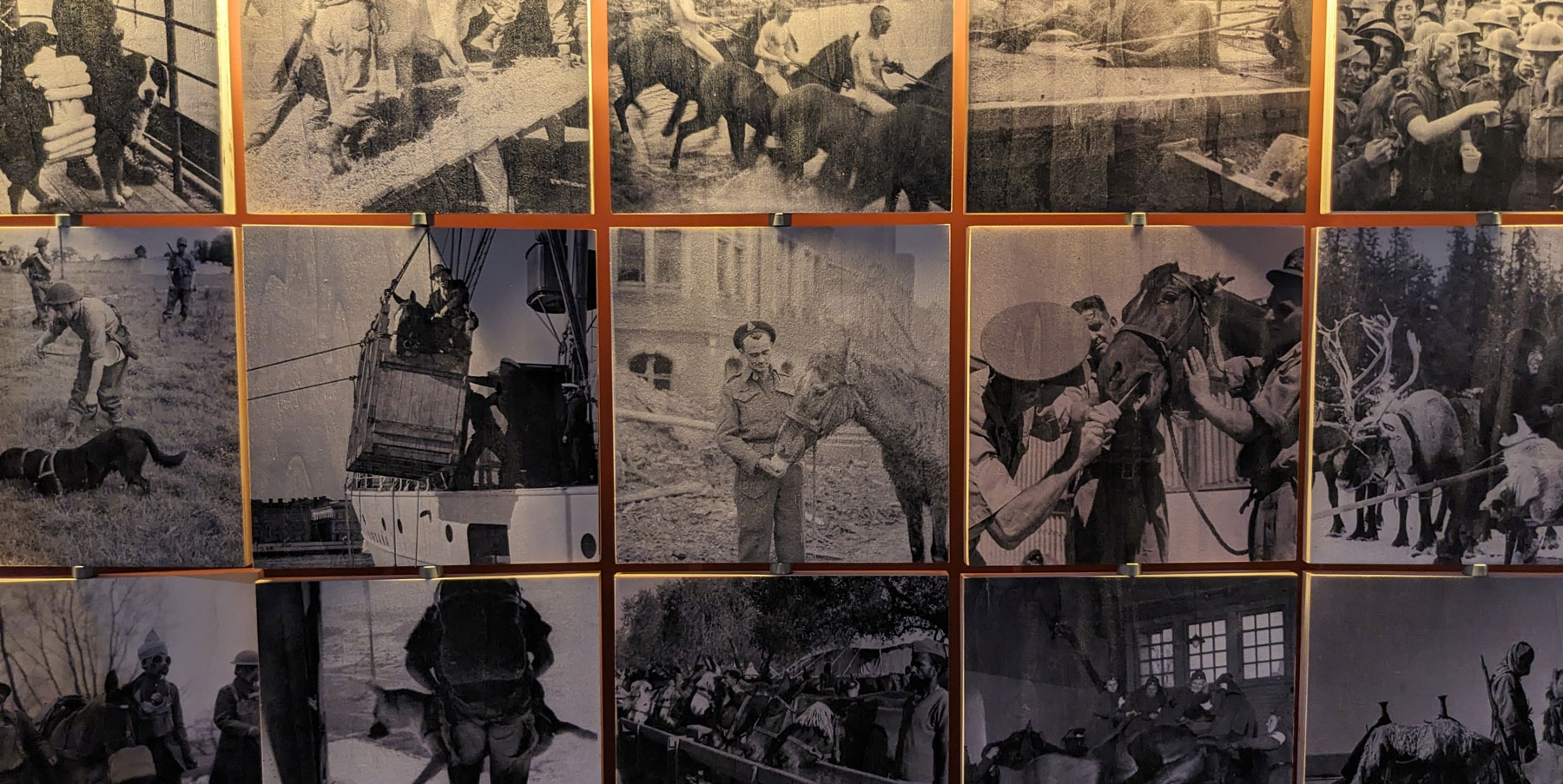
"FAUNA. Animals at War and Their People" Exhibition, Museum of the Second World War in Gdansk, Poland / Author's photo
This text is neither about glorification nor condemnation. It is about those who are often overlooked and left out of memory policies. It is an attempt to tell the story of those who have no choice and are unable to understand the causes of conflicts; the story of the roles played by various animals in the world wars and armed conflicts of the 20th and 21st centuries. But above all, it is about how people and animals endured extreme circumstances together and the emotional bonds that formed between them.
Because the involvement of animals in war is not simply a story about the use of a "resource". It is a complex system of interactions where humans and animals form new types of bonds, influencing one another. The study of animals in war falls under the broader field of anthrozoology, which examines the multidimensional relationships between humans and other species. As researcher Ryan Hediger notes, studying the role of animals in conflicts helps us rethink the very essence of war and humanity.1
Furthermore, recognizing the role of animals in supporting military operations broadens our understanding of how systems of power and control function. As philosopher and sociologist Bruno Latour notes, society is not divided into clear-cut categories of "human" and "non-human".2 Instead, there is a network of interactions in which every participant — even if their position is not equal — matters and influences the outcome.
The ones carrying the war on their backs
Horses were among the most prominent animals to participate in military operations for many centuries. They not only performed combat duties but also played a key role in troop mobility, logistics, and maintaining soldiers' morale. During World War I, horses remained indispensable, despite the advent of motor vehicles.
During World War I, the British Army alone mobilized over a million horses and mules. Some were requisitioned from farmers and private owners, while others were purchased.3
Conditions on the Western Front were particularly dire. After relentless artillery bombardment, the terrain turned into a sea of mud. Ammunition and supplies could only be delivered to the frontline by horse or mule — trucks would get stuck instantly.
Horses and mules often stood chest-deep in water and mud. Their legs became caked with mud that would not come off. Their hooves hardened and cracked. Most of the animals looked like skeletons.4
Juliet Gardiner, a British historian, emphasizes that for the horses on the Western Front, the greatest hardships were not only their injuries but also the constant fear: the animals stood for hours under fire with no cover, sank into the mud, and died from the cold, disease, and exhaustion. Wounded horses suffered pain just as much as people did.5
Caring for such a large number of animals required the creation of an entirely new system. Before World War I, veterinary medicine was generally considered a civilian profession. However, the scale of the conflict forced a reevaluation of veterinarians' roles in the military.
In 1903, the Royal Army Veterinary Corps (RAVC) was established in Britain — a revolutionary step for its time. Veterinarians developed new treatment methods, maintained herd hygiene, and formulated appropriate diets for the animals. For its service during World War I, the Veterinary Corps was granted a royal title in 1918.6
Veterinary hospitals operated around the clock under conditions akin to combat. In temporary tent camps, they treated wounded and sick horses day and night, performed complex surgeries — including amputations — and worked to return as many animals as possible to service.7
During World War I, veterinary services handled millions of cases. The recovery rate was impressive: more than half of the wounded horses were successfully returned to service.8
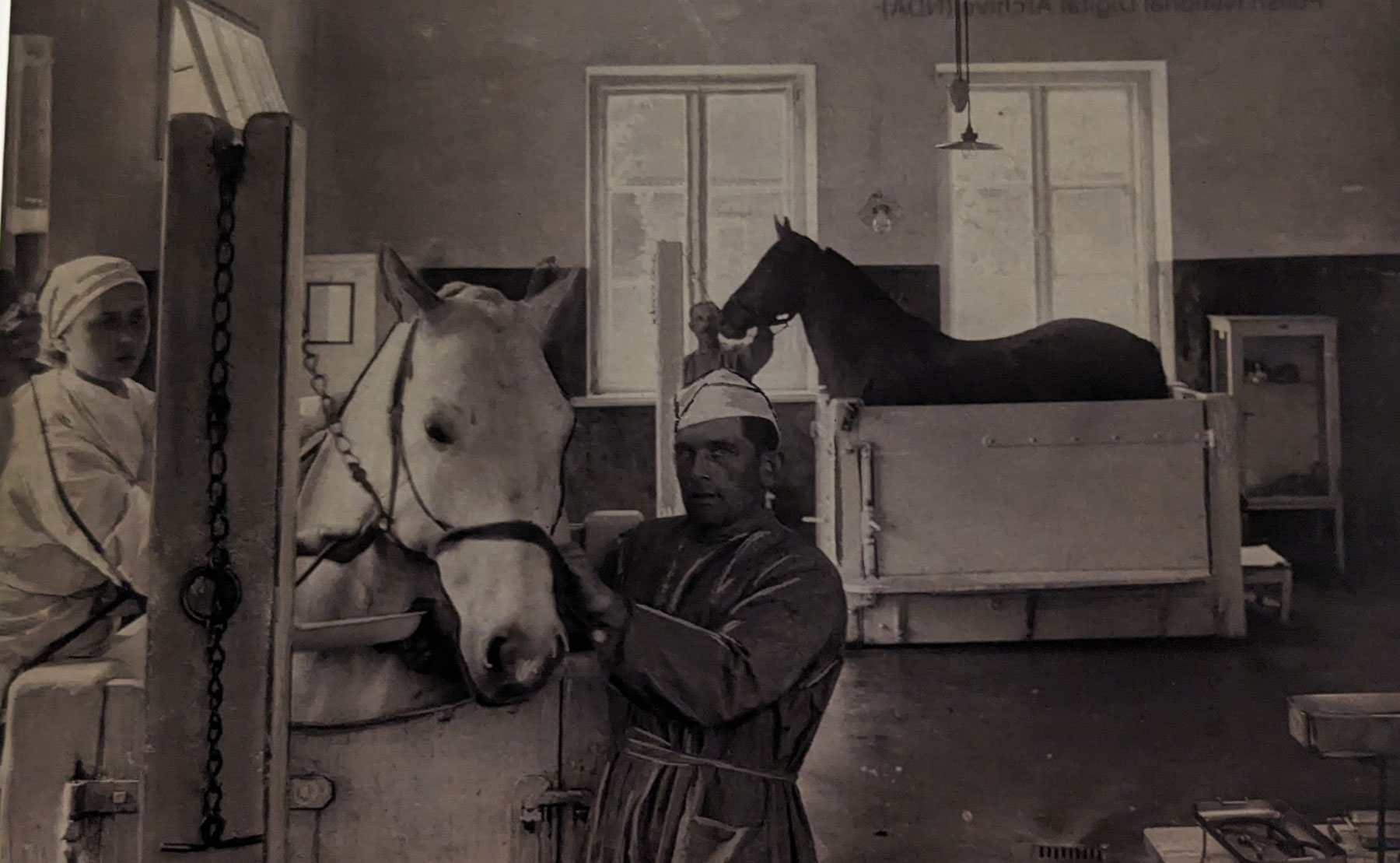
Veterinarians and horses in an animal operating room, Puławy, Poland, 1940s. / National Digital Archives (NAC), Warsaw
However, according to estimates from researchers and animal welfare organizations, approximately eight million horses, mules, and donkeys serving on all fronts perished during World War I.9 They died not only from bullets and shrapnel but also from disease, exhaustion, starvation, and pneumonia resulting from gas attacks.
The soldiers grieved deeply over the loss of their animals. Juliet Gardiner draws on letters and memoirs that reveal the depth of these feelings:
"The horse I had killed was my favourite — It was a beauty, the best horse I ever had, and it was patted a good lot in the battery, so you might guess there was an excuse for me when I cried a little over him, for I loved him."10
These emotions were not uncommon. Soldiers often gave their horses names, wrote about them in letters, and held funeral rites for them. Some officers said that losing a horse was harder than losing a soldier.
Despite their heroic service, most horses' fate after World War I was tragic. All 20,000 horses that served in Palestine were sold to Egypt. On the Western Front, many of them were sold to slaughterhouses.11
It was not until eleven years later, in 1930, that Dorothy Brook, a British woman who had moved to Cairo, saw the skeletal figures of British and Australian horses on the city streets. She visited the stone quarries and found the horses in an even more appalling condition there: perpetually hungry, emaciated, overloaded, and maimed.12 Brooke wrote a letter to the Morning Post, accompanied by a photograph of an emaciated horse she had rescued, and asked for financial assistance. The British public responded, and within a few years, £40,000 in donations had been raised. In the end, more than 5,000 former military horses were saved.13 The very fact that this movement emerged was evidence of a growing public awareness that neglecting animals is a form of injustice.
World War II is often portrayed as almost entirely mechanized. However, the Wehrmacht, for example, used about 2.75 million horses — twice as many as in World War I. It was a paradox: a nation that prided itself on its modernity was dependent on horses.14
Winged messengers
Today, pigeons mostly annoy people and are associated with dirt. But their military history reveals a different side to these birds. British journalist Jilly Cooper traces the first evidence of pigeons being used to carry messages back to 1150 B.C.15 Pigeons played an important role in many military conflicts, including both world wars. In extreme conditions, they were perhaps the only reliable means of communication.
With the advent of the telegraph and radio communication, it seemed the days of the carrier pigeon were over. However, World War I proved the opposite: pigeons were often more reliable than wires, which were easily severed under fire, or than radio signals, which could be intercepted.16
The birds were transported to the front lines in special containers that protected them from dirt. Whenever something important happened — such as the battalion being surrounded or a particular section of the front line needing reinforcements — a message was placed in a small aluminum capsule and attached to the pigeon's leg.17
Cher Ami, the famous American pigeon, delivered twelve messages during World War I. On his final flight, he lost a leg; the same bullet pierced his chest. Despite his injuries, the pigeon delivered the message capsule, which was held only by the tendon of his severed leg. The message was critically important — it described the need for immediate reinforcements, which arrived in time and saved the battalion.18
Mary from Exeter flew twenty-two missions over occupied France and was wounded three times. On one mission, she was shot in the neck; on another, she was wounded by shrapnel. Despite this, she always made it home.19
In 1942, Winkie saved the crew of a British bomber. The plane was forced to make an emergency landing in the North Sea. Once released, Winkie managed to get out of the container and, despite her wings being stuck together by oil spilled into the water, flew over 200 kilometers to the coast of Scotland. She wasn't carrying a message, but she had a code number that helped pinpoint the crew's approximate location. All crew members were rescued.20
In 1943, Maria Dickin, founder of the veterinary charitable organization People's Dispensary for Sick Animals (PDSA), established a medal for animals that had shown exceptional bravery during the war. The Dickin Medal became known as the Victoria Cross for animals.21
From 1943 until the end of World War II, the Dickin Medal was awarded 54 times: to 32 pigeons, 18 dogs, three horses, and one cat. Among the pigeons honored were Cher Ami (posthumously), Mary of Exeter, Winkie, and many others. This medal served as official recognition of the role these birds played.22
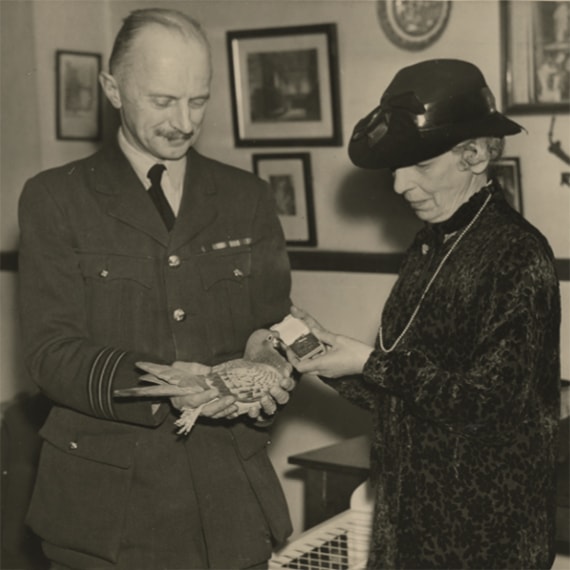
Winkie is awarded the Dickin Medal / PDSA
The losses among the pigeons were enormous. The birds often fell victim to the enemy or to natural conditions: strong winds, storms, predators, or military mistakes. During World War II alone, in France and Belgium, only 1,842 of the 16,544 pigeons released over the occupied territories returned.23
The Nazi occupation authorities were well aware of the value of carrier pigeons for resistance and partisan communications. The occupiers issued a series of bans on keeping pigeons.24 Punishments for disobedience could be severe, including the death penalty.
At the same time, German newspapers published for Ukrainians in the occupied territories carried articles on the importance of pigeon-keeping: "Pigeon-keeping is more than just a hobby; its great significance has undoubtedly proven itself in this war as well."25 It is clear that the occupiers valued pigeon post for their own purposes, but prohibited civilians from keeping birds that could be used in the resistance.
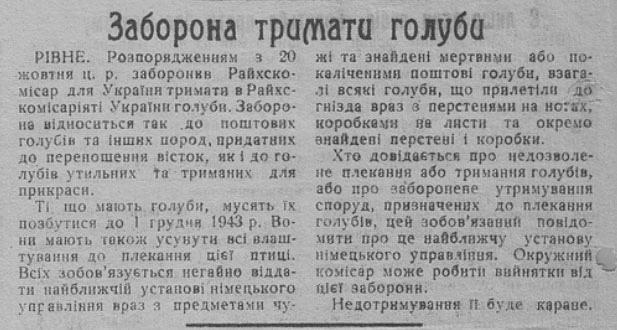
The Bar District Weekly, No. 2, 9 August, 1944, page 4 / Libraria. Digital archive of Ukrainian periodicals
Military dolphins
Even after World War II, animals continued to be used in military operations. During the Cold War, the military developed programs involving marine mammals.
The U.S. Navy's marine mammal program began in the 1950s. Dolphins were trained to locate underwater mines and detain saboteurs. During the Vietnam War, they were used to guard military ships.26
A similar program operated in the Soviet Union, focused on protecting the ports in Sevastopol. Dolphins were trained at special centers near the city. The number of animals involved remained classified.
Under such programs, dolphins undergo intensive training and may experience stress while performing tasks.27 Animal welfare organizations criticize these practices, arguing that animals cannot consent to participation in military operations.
To this day, the U.S. Navy program remains active, involving dozens of dolphins and sea lions. They have been deployed in military operations in the Persian Gulf and in Iraq.28
Following Russia's annexation of Crimea in 2014, the dolphins from the Soviet program came under Russian control. According to The Guardian, Ukrainian officers claimed that the dolphins refused to eat because they did not recognize their new coaches.29
This incident illustrates how animals are used as political symbols and propaganda tools in wars, often obscuring the complex and problematic reality of their captivity and use.
Best friends: military dogs
Even today, dogs remain among the most valuable animals in warfare. The range of tasks they perform is impressive: they can serve as sentries, bomb disposal experts, and couriers; detect ambushes and explosives; search for the wounded; and even participate in combat assaults.30
By the start of World War I, many countries already had military dog-training programs. Germany had been experimenting with the use of dogs since 1870 and had 6,000 trained dogs by the start of the war.31
Great Britain initially refused to use dogs. Only after an official trial in France in 1916, when two Airedale Terriers successfully delivered a message across unfamiliar terrain, did the War Office establish an official military dog training school.32
To ensure there were enough dogs, a public appeal was made. The response was overwhelming: owners offered more than 7,000 of their dogs for military service.33
One of the most interesting innovations of World War II was the training of paratrooper dogs. Rob, a black-and-white Collie from a farm in Shropshire, became one of the most famous. He made over twenty parachute jumps and, in February 1945, was awarded the Dickin Medal for his service.34
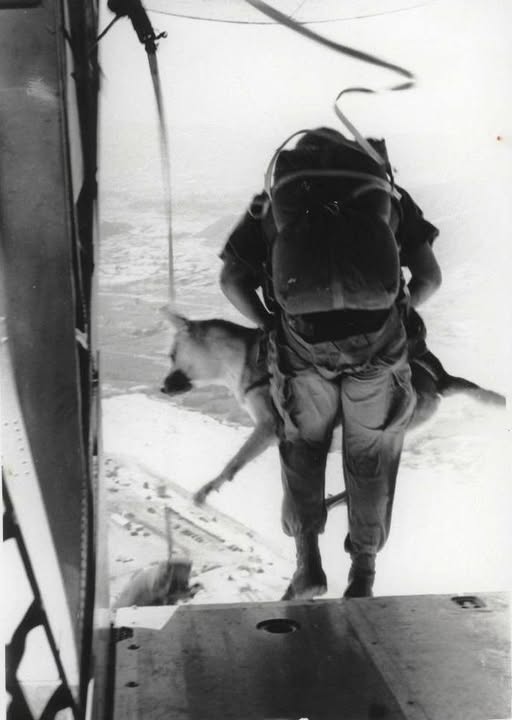
A military working dog named Lobo is being made to perform a parachute jump, Da Nang, Vietnam, 1968 / USMC archives
During the Vietnam War, approximately 4,000 dogs served in the U.S. military, primarily as patrol dogs and bomb-sniffing dogs. Only about 200 of them returned home.35
Post-traumatic stress disorder has become a pressing issue for military dogs. Some veterinarians believe that dogs can indeed experience a form of PTSD. Animals exposed to gunfire and involved in search operations often become fearful and insecure. By 2010, the treatment of PTSD in dogs had been formalized, reflecting recognition of animals' psychological needs.36
Ukrainians are well acquainted with Patron, a Jack Russell terrier from Chernihiv who serves as a bomb-disposal dog with the State Emergency Service. In the first months of the invasion, he helped defuse over 200 explosive devices, saving the lives of civilians and military personnel. In May 2022, he received an award from the President of Ukraine.37
The image of Patron is actively used by the State Emergency Service in its communication campaigns, particularly to explain safety rules to children. However, this raises a complex issue: the ease with which Patron's image has become part of the culture and is used to discuss the war could have unintended consequences. There is a risk that glorifying animals in a military context could inadvertently normalize exploitation and distort perceptions of war.
Animal rights movements
The use of animals in military conflicts is closely linked to the emergence of animal rights movements. Concerns about the fate of animals in military operations did not arise spontaneously but as part of a broader reconsideration of the rights of living beings.
The Royal Society for the Prevention of Cruelty to Animals (RSPCA) was founded in 1824 and became the first large-scale organization of its kind. During World War I, this and other animal welfare organizations actively protested against the mass slaughter of domestic animals.38
The Public Dispensary for Sick Animals (PDSA), founded in 1917, specialized in providing free veterinary care to animals of low-income people. It was the PDSA that established the Dickin Medal in 1943 as a symbolic recognition of animal heroism.39
The American Society for the Prevention of Cruelty to Animals (ASPCA) was founded by Henry Bergh in 1866.40 In the 20th century, the American movement evolved from a focus on protecting working animals to a more radical stance.
In Germany, the situation was more complicated. The Reich Animal Protection Act was passed in 1933 — one of the first of its kind in Europe — but this did not prevent the widespread use of animals during World War II. The animal rights movement in Germany gained momentum after World War II, particularly in the 1970s and 1980s, following a wave of ethical debate about animal rights, the humanization of experiments, and restrictions on military programs.41
There were no organized animal rights movements in the Soviet Union. The focus was on state veterinary services and epidemic control, but no targeted animal-rights campaign was launched. This contrasts with Western European and North American practices and illustrates how different political systems perceived and regulated human-animal relations.42
Memory and memorialization
How does society remember the animals that served and died in wars? The memorialization of animals' participation in war reveals our notions of humanity and justice.
The most famous memorial is the Animals in War Memorial, built in London in 2004. On its front side is the inscription: "This monument is dedicated to all the animals that served and died alongside British and Allied forces in wars and campaigns throughout time. They had no choice".43
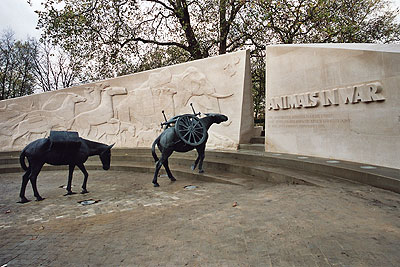
The Animals in War Memorial, London / Nicky Hughes. The Historic England Blog
However, researcher Hilda Kean criticizes such memorials, arguing that they often reinforce power dynamics between humans and animals by normalizing their use in a military context.44 There is a risk that memorials may reinforce the notion that the exploitation of animals in war is normal, as if it has always existed and always will.
Conclusions
Animals do not choose to volunteer. They are used for specific qualities and skills. The way people organize this exploitation and what happens to the animals afterward reveal deeper truths about how wars are waged and what humanity considers acceptable.
In his essay "Why Look at Animals?", British art critic and thinker John Berger reflects on how our relationship with animals has changed. He argues that in the past, people lived close to animals, worked with them, and viewed them as beings with their own agency. In the modern world, animals are largely separated from human daily life: confined to farms and zoos or kept as pets. According to Berger, this separation reveals our alienation from nature. We have come to view animals not as living beings but as objects.45
The growth of animal rights movements reflects a gradual recognition that the systematic use of living beings requires moral consideration. This does not mean that we have begun to interpret our relationship with animals correctly. But it does signify a shift in consciousness.
Ukrainian historiography has not yet established a solid tradition of studying this topic. Current records are found primarily in journalistic texts, while systematic academic research is lacking. At the same time, this topic is critically important for understanding not only military history but also how humans and other living organisms share such an extreme reality.
Recognizing animals' role in war is not merely a tribute to their suffering. It is also a way of asking: what kind of world are we creating when we expect other living beings to share in its horrors? And what can we change?
Resources
[1] Ryan Hediger, «Animals and War: Introduction» in «Animals and War: Studies of Europe and North America», Leiden: Brill, 2013, 1–6
[2] Bruno Latour, «Reassembling the Social: An Introduction to Actor-Network-Theory», Oxford: Oxford University Press, 2005
[3] Jilly Cooper, «Animals in War», London: Corgi Books, 2000, 39-41
[4] Juliet Gardiner, «The Animals’ War: Animals in Wartime from the First World War to the Present Day», London: Portrait, 2006, 42-43
[5] ibid
[6] National Army Museum, «The Royal Army Veterinary Corps»
[7] Zita Ballinger Fletcher, «How the British Cared for Military Animals During WWI», HistoryNet, 2023
[8] Jilly Cooper, «Animals in War», 49
[9] «War Horse Facts», The Brooke
[10] Juliet Gardiner, «The Animals’ War: Animals in Wartime from the First World War to the Present Day», 52
[11] Jilly Cooper, «Animals in War», 64
[12] Juliet Gardiner, «The Animals’ War: Animals in Wartime from the First World War to the Present Day», 160-161
[13] Jilly Cooper, «Animals in War», 65
[14] Jilly Cooper, «Animals in War», 12; 65
[15] Jilly Cooper, «Animals in War», 97
[16] ibid
[17] Juliet Gardiner, «The Animals’ War: Animals in Wartime from the First World War to the Present Day», 104
[18] Juliet Gardiner, «The Animals’ War: Animals in Wartime from the First World War to the Present Day», 99
[19] Jilly Cooper, «Animals in War», 106-107; «Mary of Exeter», PDSA
[20] Jilly Cooper, «Animals in War», 105
[21] «Our History», PDSA
[22] ibid
[23] Juliet Gardiner, «The Animals’ War: Animals in Wartime from the First World War to the Present Day», 102
[24] "Ban On Keeping Pigeons", Tyzhnevyk Barskoi okruhy (The Bar District Weekly), No. 2, January 9, 1944, 4
[25] "Carrier Pigeons In Wartime", Nova Doba (New Era), Berlin, No. 35, August 29, 1943, 4
[26] Juliet Gardiner, «The Animals’ War: Animals in Wartime from the First World War to the Present Day», 108-110
[27] «Use of Dolphins by the U.S. Navy», Dolphin Project
[28] Emily Anthes, «The Navy’s Aging Dolphins», New York Times, January 31, 2023
[29] «Ukraine Claims Dolphin Army Captured by Russia Went on Hunger Strike», The Guardian, May 16, 2018
[30] Juliet Gardiner, «The Animals’ War: Animals in Wartime from the First World War to the Present Day», 86
[31] Jilly Cooper, «Animals in War», 73
[32] Jilly Cooper, «Animals in War», 74–76
[33] ibid
[34] Juliet Gardiner, «The Animals’ War: Animals in Wartime from the First World War to the Present Day», 32-33
[36] Janet M. Alger and Steven F. Alger, «Canine Soldiers, Mascots, and Stray Dogs in U.S. Wars: Ethical Considerations» in «Animals and War: Studies of Europe and North America», ed. Ryan Hediger, Leiden: Brill, 2013, 96
[37] Oleh Pavliuk, "Patron the Dog Received Award from Zelenskyi", Suspilne Media, 2022
[38] «Our History», RSPCA
[39] «Our History», PDSA
[40] «History of the ASPCA», ASPCA
[41] «The First German Animal Welfare Law», Deutschlandmuseum
[42] «Animals as Assets: Exploitation and Utility in the USSR», Comrade Gallery
[43] «Animals in War Memorial», Animals in War Memorial Fund
[44] Hilda Kean, «Animals and War Memorials: Different Approaches to Commemorating the Human–Animal Relationship» in «Animals and War: Studies of Europe and North America», ed. Ryan Hediger, Leiden: Brill, 2013, 239-243
[45] John Berger, «Why Look at Animals?» in «About Looking», New York: Pantheon Books, 1980, 1–26
Text: Sofiia Nazaruk
Translation: Dariia Titarova