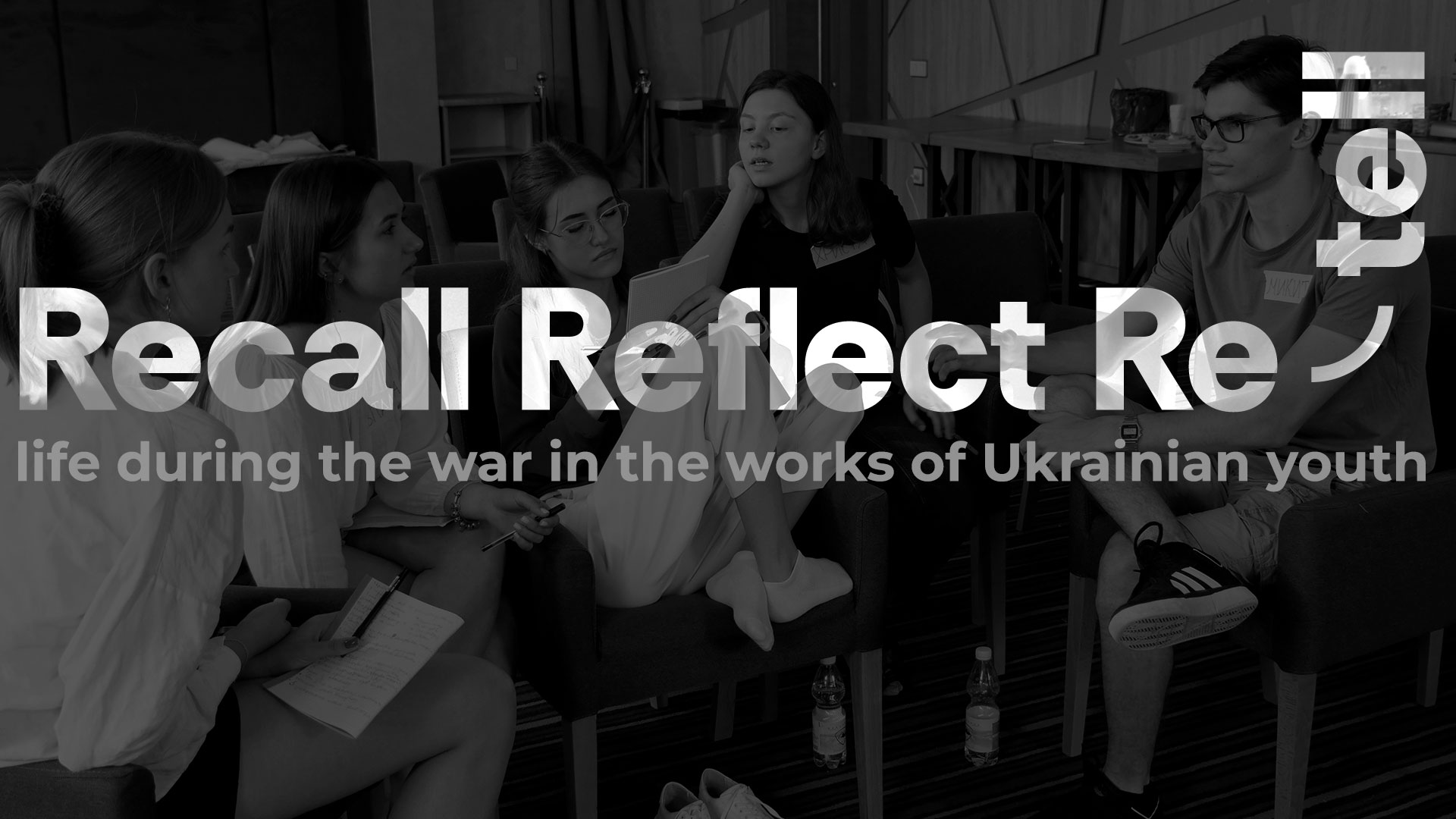
Recall Reflect Retell
life during the war in the works of Ukrainian youth
It is a virtual exhibition about the everyday life and emotional dimension of the Russian-Ukrainian war, about current and historical experiences of Ukraine, about topics that were talked through or silenced in families, and about the continuation of the struggle for freedom. These are fragments of the Ukrainian present and past which are connected by the common context and the lens of youth. The presented works are created by young Ukrainians who live in Ukraine or abroad and use different formats and techniques.
A joint project of Gestapokeller und Augustaschacht Memorial Association (Germany) and After Silence public organization (Ukraine).
Read more…
Mykyta Bilyi, Marichka Soltysik
Gazeta Project
Mykyta: 22, culturologist, archivist
Drohobych (Lviv region)Lviv
Marichka: 22, culturologist, cultural manager
Boryslav (Lviv region)Lviv
Studying newspapers of the late Soviet period, Mykyta and Marichka compare narratives of military topics in the USSR media to the contemporary Ukrainian and Russian narratives about the war in Ukraine and visualize them in “Gazeta Project” collages.
Yehor Harmash
The Living and TheDead
22, director
NikopolKyiv
Through his “The Living and The Dead” collage project, Yehor tells how his godmother asked him to send her father’s ashes by post to another town and reflects on the nature of (lack of) care in society today when tragedy and death surround us daily.
Larysa Kozak
Field Research on Crimea
21, philologist
Yaremche (Ivano-Frankivsk Oblast)
“Field Research on Crimea” essay describes memories of Larysa’s parents about their honeymoon trip to Crimea in 2001. They dreamt of coming back there with their daughter but missed a chance because of the Russian occupation of the peninsula.
Sofiia Kostenko
44 22
19, journalist
Sumy
Sofiia found out she was a Crimean Tatar at 12. “44/22” tells about her family deported from their native Crimea by the Soviets along with a story of a Crimean Tatar woman who was recently forced to leave the peninsula due to persecution by Russia.
Leeza Svyrydenko
Why Are People Unhappy ?
26, director
DonetskKyiv
“Why Are People Unhappy?” is a film about feelings that Leeza has had for 10 years — the pain of a displaced person who had to move due to the Russian occupation of Donetsk, her hometown. Leeza created this film in collaboration with a younger herself based on videos she recorded as a 10-13-year-old girl.
Anny Gareeva
The Shadows of the Battles
20, photographer
KharkivChernivtsi
“The Shadows of the Battles” photo series is the story of Anny’s husband, a serviceman who returned home from the front but whose mind is still in the war. It is a visual chronicle of his daily life — emotions and concerns, fears and dreams, and changes that the war brought to the family’s life.
Anna Trifonova
A Century-Long Journey Through Family History
18, studies architecture and urban planning
DonetskKryvyi Rih
The essay “A Century-Long Journey Through Family History” introduces us to Anna’s five generations of her family, whose lives were influenced by wars of different times — from her great-grandfather's German captivity in World War I to her father's imprisonment in the Russian Izolyatsia torture prison and the author herself, a displaced person from Donetsk city.
Maryna Shkrabaliuk
A small black untitled film
21, director
Ukrainka (Kyiv Oblast)Kyiv
In “A small black untitled film” project, Maryna prepared life references and own reflections that will serve as a foundation for the film about the servicemen who want to go home and their relatives who wait for them and try to overcome the war-driven gap between them.
Anna Andrieieva
Memory box
24, historian, Ukrainian Armed Forces servicewoman
PereiaslavIvano-Frankivsk
In a “Memory box” video essay, Anna looks through a family photo archive and tells the story of her grandmother, who was sent to Nazi Germany for forced work during World War II.
Artem Baidala
Maldives at Home
22, photographer, designer
DniproKyiv
Artem explores how the war influenced the recreational practices of Ukrainians and how the land can drastically change its purpose with time in his “Maldives at Home” multimedia project about a popular beach in the Dnipro region near Vilnohirsk town.
Mykyta Bezus
Traces of Memory
20, photographer, videographer, law student
KamianskeKyiv
In his “Traces of Memory” film, Mykyta reconstructs the story of his great-grandmother, who was sent to Nazi Germany for forced work, and observes how the interest in family story passes from his grandfather-researcher to a grandson — the author of this film.
Viktoriia Bura-Chebotar
Ukrzaliznytsia’s platzcarts
19, poetry and prose author, philology student
KovelDrohobych
In a zine entitled "Ukrzaliznytsia’s platzcarts", Viktoriia describes her experience of traveling alone for the first time during the full-scale war from Drohobych in the west to Kyiv in the center of the country, where she had never been before, and reflects on whether such journeys are appropriate.
Renata Chechel
War Childhood
20, student of political studies
ZaporizhzhiaKyiv
Renata’s interviews are the stories of Ukrainian children whose lives changed under the influence of the war in 2014 and after the start of the full-scale invasion of Russia into Ukraine in 2022. In the spring of 2023, the story about the Dragon became a part of the exhibition at the Ukrainian Department of the War Childhood Museum (Sarajevo, Bosnia and Herzegovina) that Renata coordinates.
Snizhana Chorna
Everyday life as a form of survival
24, designer with a specialty in cognitive science
LvivKrakow (Poland)
Snizhana observes the non-obvious impact of the war on daily life. With her video “Everyday life as a form of survival”, she invites viewers to peek at the routine and thoughts of three girls from Kyiv, Lviv, and Odesa and look at how their lives changed after February 24, 2022.
Viktoriia Kolosova
Eyes that Saw
19, publishing and printing student
MariupolLviv
“Eyes that Saw” project is a collection of amateur photos related to the full-scale war and stories behind the pictures which are aimed to draw attention to the war in Ukraine and what Ukrainians are going through.
Khrystia Leshchuk
The girls of Maslosoyuz
21, student of history, philology, and cultural studies
Lviv
“Women from Maslosoiuz Cooperative” essay tells about Khrystia’s relatives, mainly about women who impacted her grandmother — grandmother’s mother and stepmother who are connected by one husband, Kalush town and Maslosoiuz cooperative.
Mariia Mishankova
The Effect
19, illustrator
ZaporizhzhiaPrague (Czech Republic)
Mariia demonstrates three stages of experiencing traumatic events in wartime in her “The Effect” triptych: from the shock and chaos through acceptance and adaptation to reincarnation — a new life where trauma exists as an imprint.
Lera Nilova
Iʼm fine
23, designer, illustrator
Kyiv
Lera works with “uncomfortable” stories of young Ukrainians who were affected by the Russian war. “Iʼm fine” zine tells the story of Lera’s friend from Donetsk who loses her home and close people. Nevertheless, she tries to make the most of her young life.
Kateryna Omelianenko
The Only One to Care
20, student of animated film direction, illustrator
KyivBratislava (Slovakia)
In her “The Only One to Care” animated film, Kateryna uses her family story to draw attention to people who take care of relatives with disabilities or dementia and whose already difficult lives have been exacerbated because of war and the need to evacuate.
Anastasiia Opryshchenko
The Work of Grief
24, journalist, comic book artist
Kyiv
What do women think and feel who have lost their loved ones in the war and try to live with the emptiness inside? “The Work of Grief” comic tells stories of two young widows whose husbands died defending Ukraine from Russian invasion.
Anastasiia Pashchenko
Camp
25, director
KyivPrague (Czech Republic)
“Camp” is a short film by Anastasiia, an allusion to the Russian propaganda. Two children witness how an alien appears and film it. But this leads their parents to send children to the camp for re-education.
Anastasiia Pliuta
Memory That Will Unite Us
19, applied history student
LvivPavlohrad
Anastasiia collected stories of students from her university in a project entitled “Memory That Will Unite Us”. The stories are about the changes in lives of students during the full-scale war to unite them, let them share experiences, and keep in touch. The first text tells the story of Denys, who is now studying in Poland.
Yuliia Taradiuk
Pies and Identity
20, English philology student, photographer
LutskVilnius (Lithuania)
Yuliia is interested in the culture of Karaites — one of the Crimea indigenous peoples — and their communities outside the peninsula. Yuliia’s text “Pies and Identity” offers us to think with her characters about what influences our self-awareness more: upbringing and environment or our own search.
Oleksandra Vazianova
Despcrying
25, visual artist
MariupolIrpin
“Despcrying” is a collection of Oleksandra’s poems written after February 24, 2022, in her hometown Mariupol, in Germany, and after her return to Ukraine. The poetry reflects the feelings of thousands of Ukrainians at home, in occupation, and as refugees.
Bohdana Zaiats
Dust particles/dust practices
21, student of the Academy of Fine Arts
KyivPrague (Czech Republic)
Bohdana works on topics of memory and commemoration using artistic practices. Her project “Dust particles/dust practices” is Bohdana’s reflections on how we remember the tragedies of the past and how we will remember the events and experiences of current time.