22, fashion director, artist
Bolhrad (Odesa region)Lviv
Each of us, wrapped in the blanket of the great collective pain of war, carries personal concerns. We share them with others to lighten the burden, even if only slightly. This creates an endless exchange of pain that brings some relief, yet at the same time becomes another heavy burden.
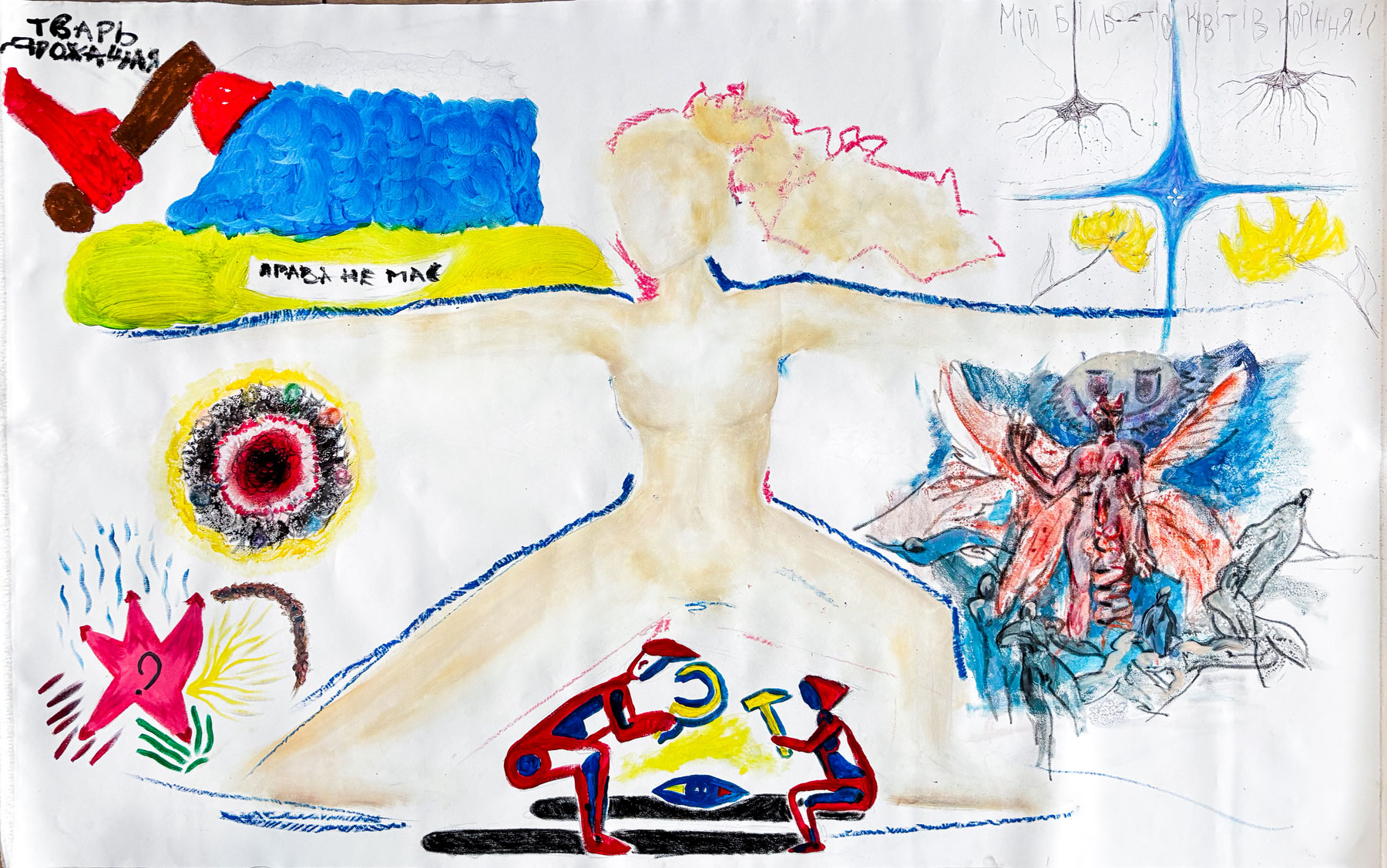
My painting depicts collective pain, drawn from contributions by participants in the "Recall, Reflect, Retell" public history work camps. At the center of the canvas is a woman in a warrior's pose, trying to maintain her balance. She is surrounded by expressive sketches of others' emotions, whose voices and stories intertwine in a shared space. This image shows how each of us tries to hold it together while the pain of others, like a bullet, pierces the soul from within. It is a burden that cannot be avoided, but it is easier to bear together.
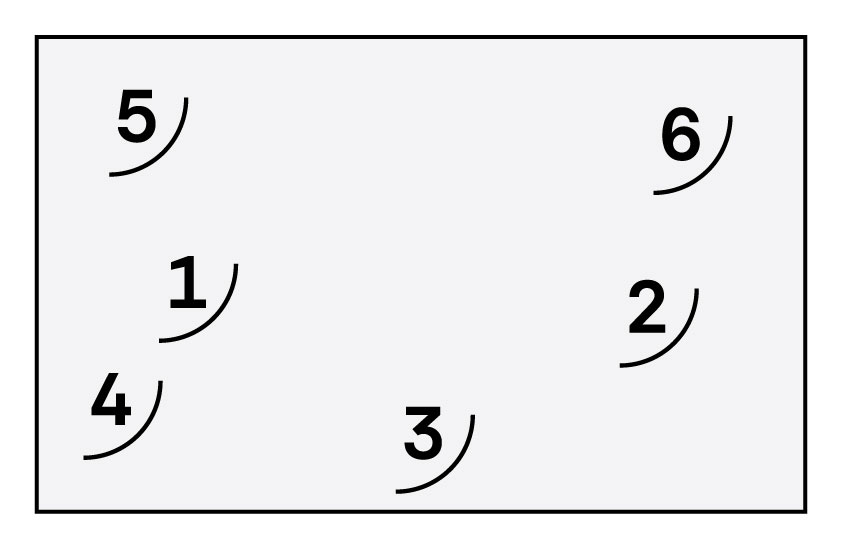
1) Veronika Liakh
This really reflects my state of mind. This red ball is like my soul. I feel like I have a red soul. Maybe it's because red is my favorite color. Inside my soul, this blot — it really expresses my constant state of anxiety, confusion, and feeling lost within myself. I gave my soul the shape of a flower, and around this flower I have black thorns. And I hurt myself with these thorns, which is why the tips of my flower's petals are red, because I'm the only one they hurt. But these thorns are surrounded by the atmosphere and souls of other people. They are lighter. They touch my soul, and they do not get hurt. Because I allow people to touch my soul, and I have no intention of hurting them.
2) Mykyta Tokarchuk
I drew the Assyrian-Akkadian demon Pazuzu. He's… well, I imagine him as if he were recreated as a LabubuLabubu is a viral collectible plush toy shaped like a monster.. I tried to reflect on the idea of domesticating evil, taming evil, and its immediate manifestation in our world. It seems to me that with this story of appropriating a terrifying demon from Mesopotamian mythology of the 1st millennium BCE into a harmless toy, one can draw parallels to our reality of the Russian-Ukrainian war. When missiles that bring death are turned into funny keychains. Like, fuck you, we will turn these instruments of mass murder into some cool trinkets. Just as you can bring back a magnet from Auschwitz or other memorial sites that have been commercialized. You can take a little piece of it back home with you and, in this way, touch this evil, this totality, scrape off a bit of it, and thus make it less overwhelming, perhaps less horrific in its effect.
3) Oleh Levii
I'm currently working on a piece about Soviet identity, about how history was erased during the Soviet era. It's a reimagined version of an old children's toy. Instead of the little blacksmiths, I placed a male worker and a female collective farmer and put a hammer and sickle in their hands, as if they were about to strike the anvil. But the idea is that the hammer and sickle never actually come together, which I find interesting. As I explore my small homeland and myself through this, I feel that I've inherited a great deal from the Soviet Union — a time I wasn't even born in — through my mother, my grandmother, and the way I was raised. And there remains a great deal of indifference toward our history. And so I'm trying to explore what was done to us, why we're completely indifferent to everything.
4) Anna Kurnytska
My favorite cartoon is SpongeBob SquarePants. And the more you watch it, the more you start to understand all the characters. And I think Patrick is really underrated. Because he's a really chill guy, but at the same time, he's kind of depressed. It turned out to be a surprisingly deep piece of work for me. New elements appeared quite by accident during the process, and it was really a reflection of how different I feel right now. I have borderline personality disorder, and it's really hard to live with this shit. But I recently started psychotherapy. I'm learning to live with it. Basically, I painted all these different sides of myself here, which I’m learning to control. And this question mark is about the core of myself, which I haven't reached yet. Because the thing about borderline personality disorder is that you kind of absorb other people, like you're putting on their personal identities. And getting to your core becomes very difficult. Getting to know yourself is always difficult. And I understand that I have many sides, but at the same time, I'm closed off from all of these sides, good or bad. These little hats... I accidentally went over the edges, but then I thought that I really am closed off on all sides, unable to fully express myself. When I'm comfortable, my clown mode might kick in. It's sincere, but overall, it's very hard for me to let anything in.
5) Zhora Papoian
I can't get Dostoevsky and his RaskolnikovRodion Raskolnikov is the main character of the novel Crime and Punishment by the Russian writer Fyodor Dostoevsky. out of my head. So I had this idea to draw an axe striking something that has absolutely no effect on. And I thought: what could this GigaRaskolnikov's axe strike? A copy of KobzarKobzar is the first collection of poems by the Ukrainian poet Taras Shevchenko, published in 1840, which is of outstanding significance for Ukrainian literature and the development of Ukrainian national self-awareness.? No, because the axe would still destroy the paper. And then I remembered Polanski's film Knife in the Water, and I understood this wonderful metaphor. Water is the only substance that remains unharmed when struck by the axe. And then I remembered my Azov Sea, which in the drawing actually looks like some kind of car from "Cars""Cars" is an American animated sports comedy film.. But yes, I ended up writing "a trembling bastard has no rights," because it really doesn't have any.
6) Nika Vertsanova
In the middle is a star. It's blue, and to me it symbolizes the night. And at the bottom, you can see two little yellow flowers. I've forgotten what they look like. Here, they look a bit like daisies, a bit like lilies. But generally, they're evening primroses. The funny thing is that these flowers only bloom when the sun goes down, right around 8 or 9 p.m. And when the sun is up, they're closed. And so the star means that it's night now, and that's why these flowers have bloomed. And at the top are the roots of the flowers, with an inscription that says, "My pain is the roots of the flowers." And for me, this is about that collective trauma, about how we very often feel distanced from our roots. These severed roots at the top are precisely a symbol of this distance and this trauma that so many people are experiencing right now. It's very difficult to reconnect with our roots, and we try to do so through certain symbols. And these flowers have become a symbol of home for me.
Video about work on the project:
Painting, video, text: Yelyzaveta Holubieva
Featuring Nika Vertsanova, Anna Kurnytska, Oleh Levii, Veronika Liakh, Zhora Papoian, and Mykyta Tokarchuk