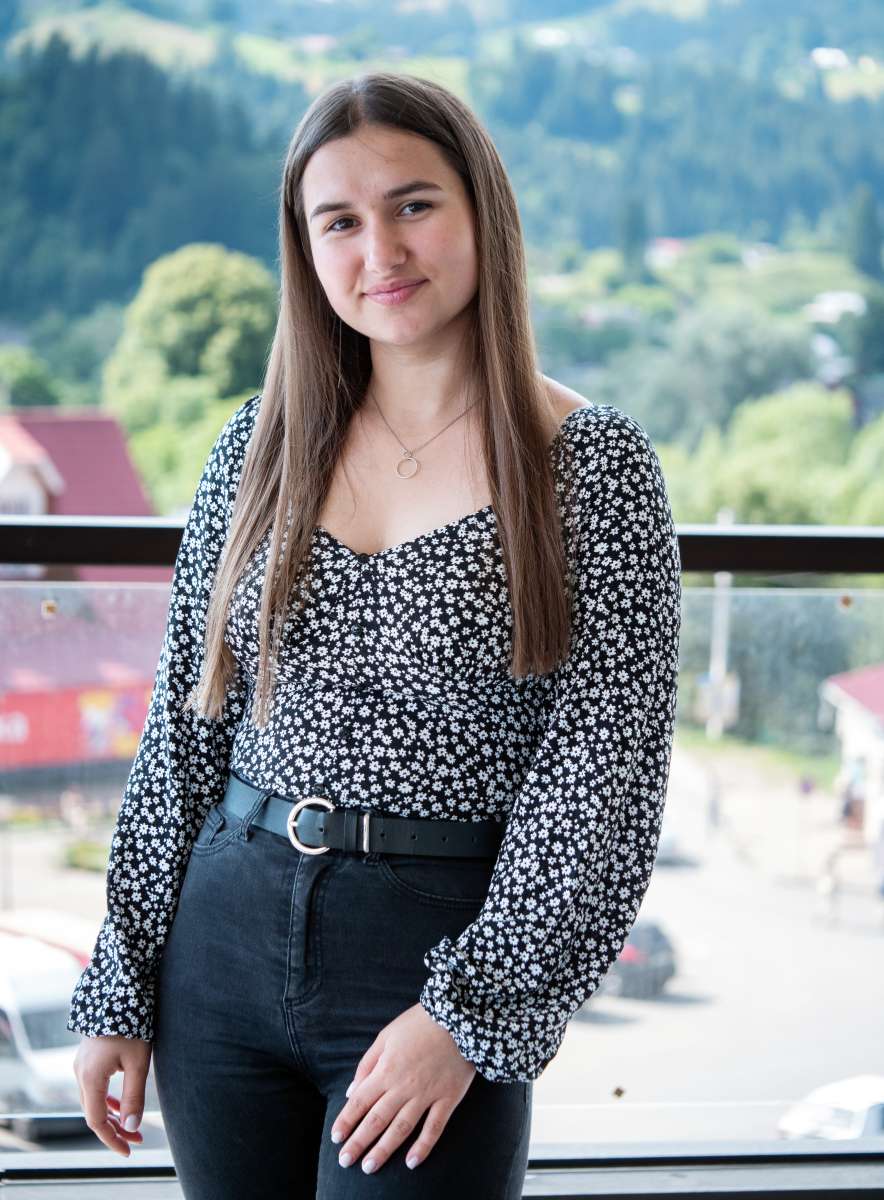
23, historian, art historian
Kvitky village, Cherkasy regionKyiv
A portrait of a young woman hangs on the wall at my great-grandmother Olha Tryhub’s (née Datsko) house. It is covered with an embroidered towel like an icon. The woman in this portrait is her sister Yevdokia Datsko and my great-grandaunt whom I have never seen and whom I will never meet. Dunia (as family members called Yevdokia) died more than 80 years ago during World War II. Only several things remained after her such as some photos, documents, her favorite scarf, and her younger sister’s fragmentary memories. Great-grandmother Olha told me often about Yevdokia’s life and death but, unfortunately, she knew very little about her. I always wanted to meet Dunia but the only way to do it now is to try to find out a bit more about her life through her belongings and memories that are yet left.
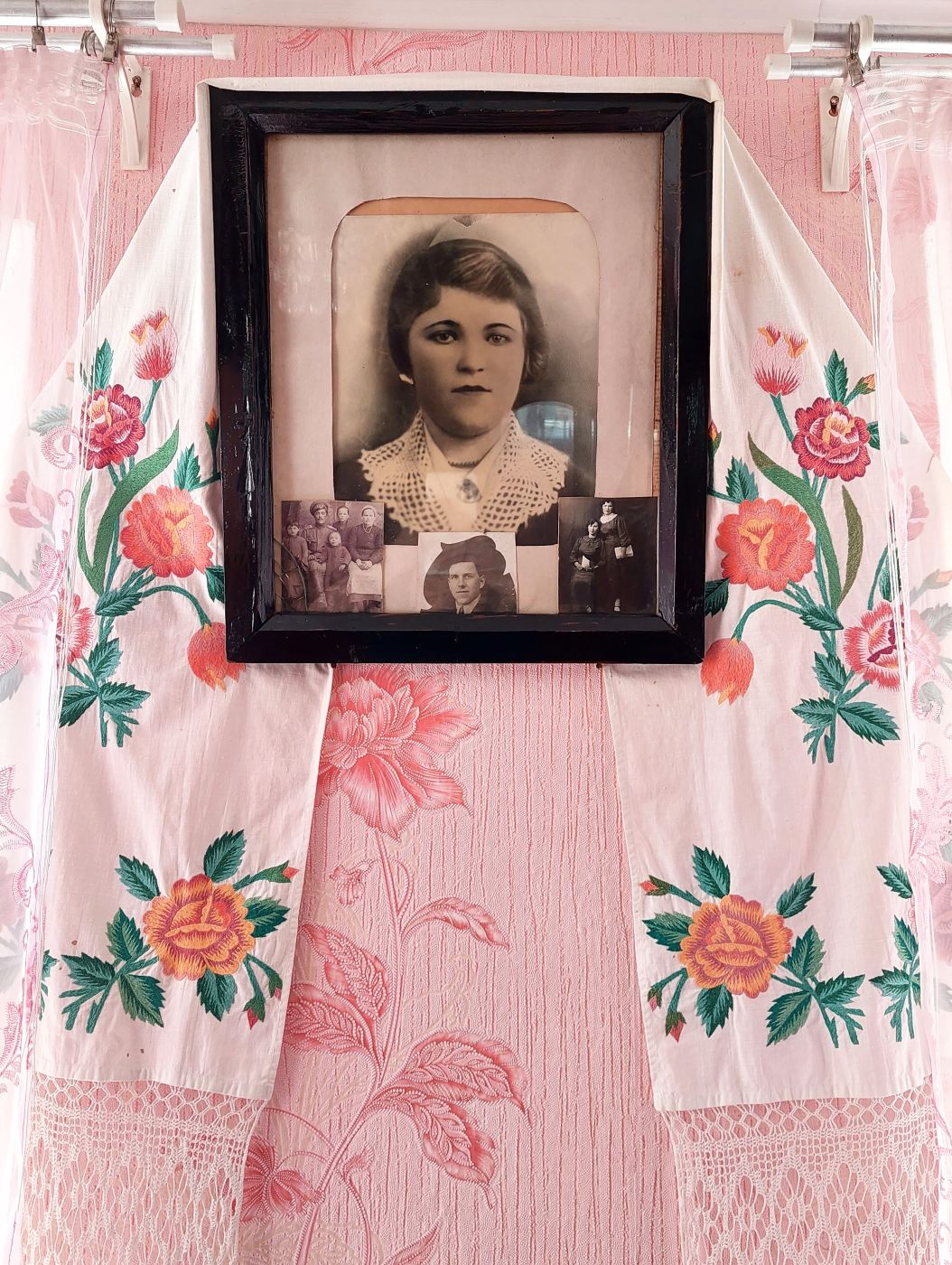
Yevdokia Datsko’s portrait in the house of her younger sister Olha Tryhub (née Datsko). Kvitky village, August 2023.
Childhood in Kvitky
Yevdokia Datsko was born on March 17, 1921, in Kvitky (Eng. flowers) village, Kyiv governorate (Ukr. huberniia) of Ukrainian SSR (now – Cherkasy region, Ukraine). Her father, Mykhailo Datsko (born in 1895), and mother, Yevfymia Lantukh (born in 1898), got married on September 18, 1919.
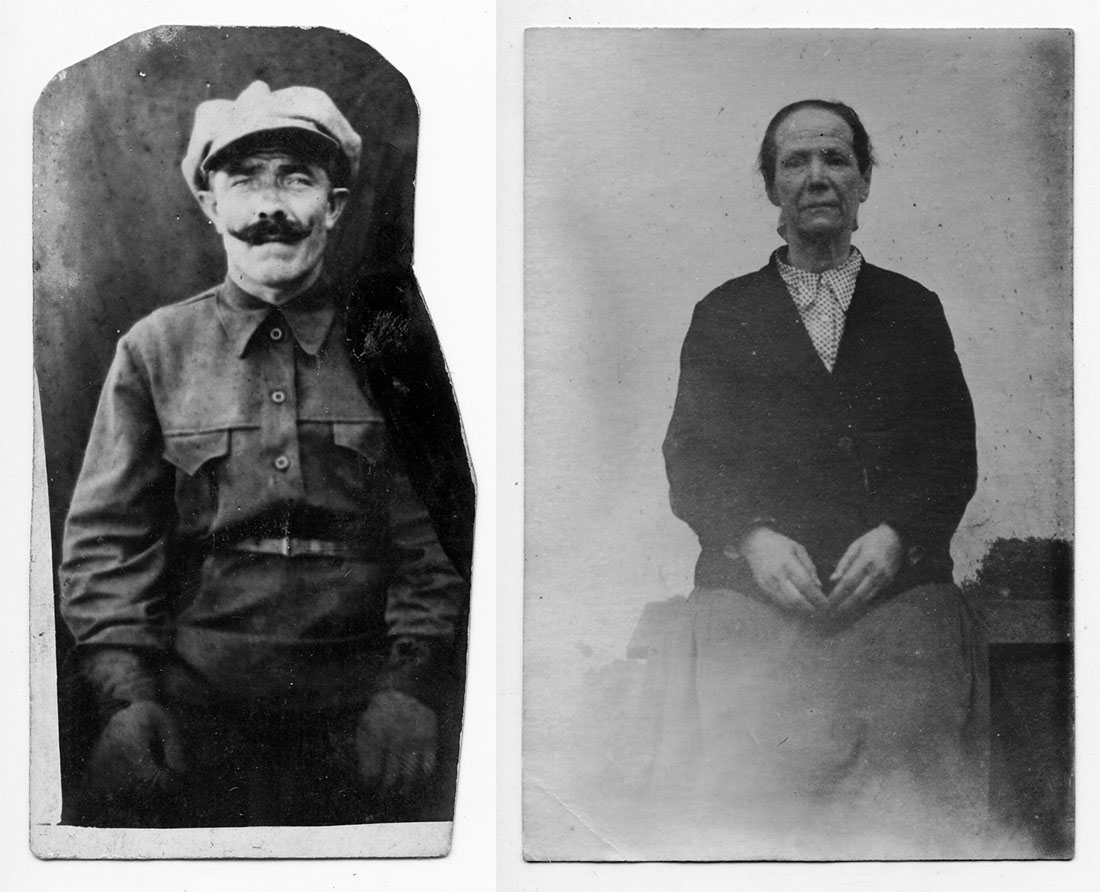
Mykhailo Datsko, approx. 1920s, and Yevfymia Datsko (née Lantukh), 1950s. Family archive
Yevdokia was the eldest child in the family. Later, Olha (1939) and Volodymyr (1926) were born. Volodymyr died of pertussis when he was 8 or 9 months old. I have also found out from my great-grandmother that her parents had had one more daughter, Hanna, but, most likely, she died immediately after birth. There is no other information about her.
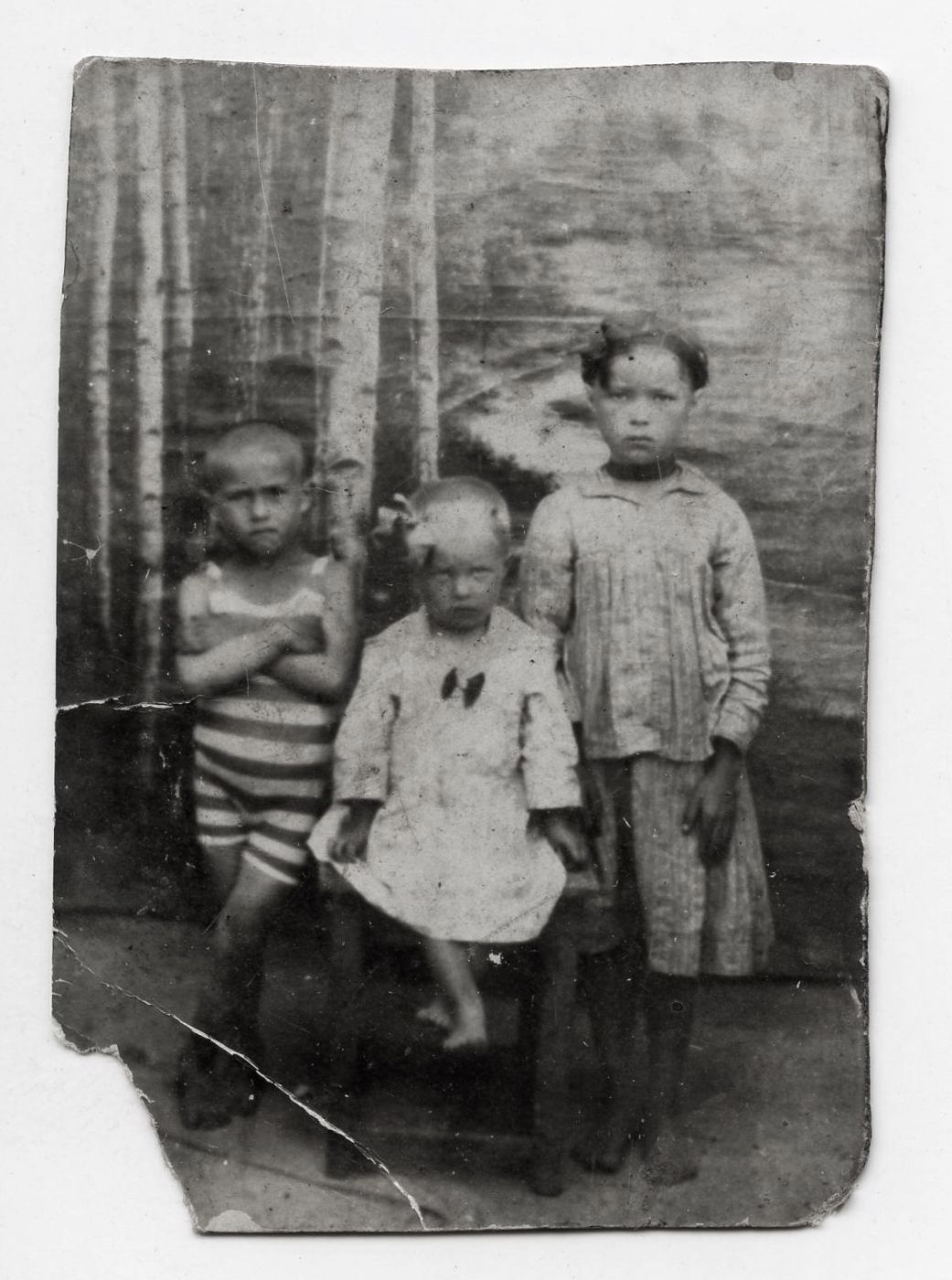
Yevdokia Datsko (on the right) with her younger sister Olha Datsko (in the middle) and a neighboring boy (on the left) who is indicated as “Shura” on the other side of the picture, 1927. Family archive
Being born in a Ukrainian village in the 20th century was followed by many challenges and Dunia’s childhood in Kvitky village was no exception. Despite the opposition, the Soviet regime was established in the village in 1923. After a while, the new government started a collectivization policy in Kvitky and other Ukrainian settlements – a forced unity of personal farms in big collective ones that are subordinate to the state. Two collective farms were organized in the village: one was named after Kliment Voroshylov – head of the Soviet military department in 1925-1940, and another – after the second five-year plan. As my great-grandmother recollects, her family had had lands outside the village and by the house and cattle before the collectivization period. The head of the local museum Larysa Tsiomenko wrote down these memories in the book called Kvitky Village and Its Residents: Pages of Human Memory:
Our family owned little pieces of land in three places, up to three hectares in total. We had less than 2 acres by the house, a piece of land by the Hlushky forest where we always sowed wheat. I remember how I and my sister brought food there to our father. And on our way, there was a pit where a horse’s skull lay. My sister always warned me that it chased us so I wouldn’t cry and complain that I was tired. The rye was sowed on the land at Pishchane district where the farms are now built. We had a cow that died of anthrax [an acute infectious disease], a horse, and all the tools for land cultivation: a plow, harrow, mower, thresher, winnower… My mother didn’t want to enter the collective farm for a long time. We had the land, the horse, and all the equipment taken away from us as soon as my father joined the collective farm.
Then, Holodomor began, the period in which the family could survive only because the mother baked pancakes out of acacia, linden blossom, and goosefoot. My great-grandmother told me that sometimes her mother added a bit of flour that her father had buried in the vegetable garden to those pancakes. They had a cow for some more time, so milk enriched their diet:
Pancakes out of acacia, linden blossom, quinoa. We girls called these pancakes khvatopeky. My mother made better pancakes, these khvatopeky. She added more flour. Sometimes she even baked bread. Mixed different stuff that I’ve just mentioned but it was similar to bread. My mother would cut a slice of bread for me and pour milk in a cup – it was a big pottery cup – and say: “Sit and eat.” And I hold that piece of bread closer to the cup, the cupis big, and I take a bit of bread and it is left less and less. Mum yells at me: “Holia [a variation of name Olha], bite less bread and drink more milk.”
Due to the famine in 1932-1933 in Kvitky, about 600 villagers died, according to different sources. My great-grandmother recollected that whole families with five or more children died of hunger back then. People passed away in their homes or just on the streets where their breathless bodies lay for some time. She also said that her parents forbade her and Dunia to go outside for security reasons because the gossip about cannibalism cases went around the village. The Datsko family had only four people, and I assume that it helped them to stay alive.
In about 1934, father Mykhailo was sentenced to 5 years for stealing millet from the collective farm. My great-grandmother shared this episode for a book about Kvitky residents:
Together with fellow villagers, he [father] transported grain to Korsunneighboring town in the procurement point, and there they divided a sack of millet between each other. My father took the least, but he accepted the blame for the theft because he had the smallest family. He served his sentence in Siberia skidding the woodcollecting and transporting logs.
When the father was imprisoned, the mother had to work hard on the collective farm in order to sustain the family. Dunia and Olha often stayed home alone, therefore, the most memorable moments for my great-grandmother of that time were visits to her aunt Motria Tsion – a mother’s sister who lived on the other side of the village. Once, Motria had given her nieces an embroidered shirt that Dunia wore for the performance in the amateur group in Kvitky, and Olha dressed in it after the war at her wedding. There is a photo of Yevdokia in this shirt ready to perform on the stage. The shirt has also been preserved and it is our family heirloom now.
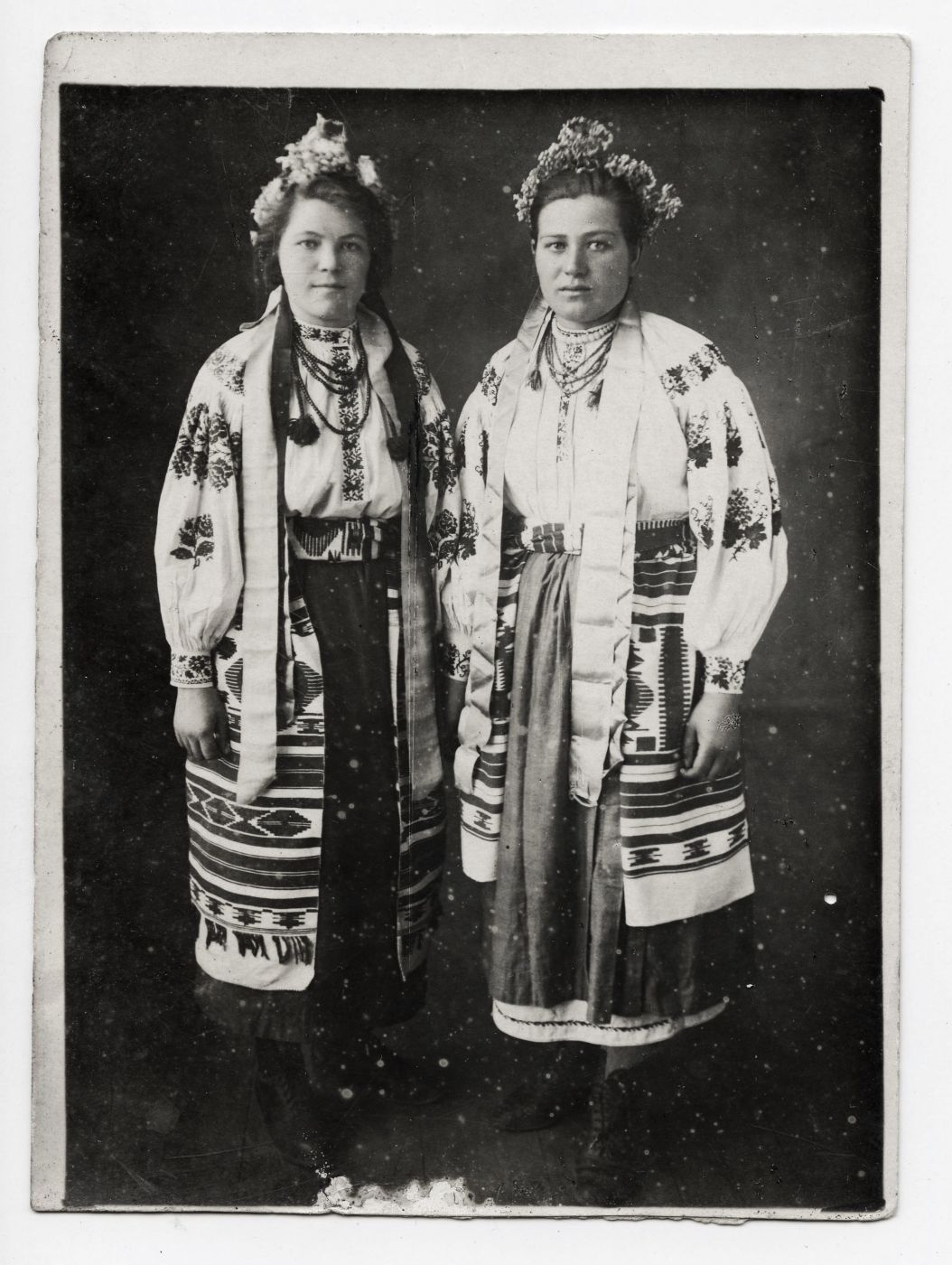
Yevdokia Datsko (on the left) with a friend Hanna Ilchenko (née Mykytenko) on the day of performance in the amateur group in Kvitky, approx. the 1930s. Family archive
Despite a challenging childhood, Yevdokia managed to graduate from the local school. According to great-grandmother’s memories, Dunia spent 7 or 8 years at school, had an aptitude for science and a good level of literacy, and dreamt of studying medicine. Unfortunately, my great-grandmother Olha barely remembers her sister at that period, but she could recollect the following episode of her life:
She studied well at school. She did not have books for learning subjects, therefore, she got together with her friends and learned. My sister had many friends and what’s more, they were mostly older than her. It was not easy to get a book then, kids did not have enough books, so they gathered in our house. She always collected her friends. Even though they were older, they all respected her very much – from a little one to a grown-up. She was kind and attractive, had a good character, she loved big companies.
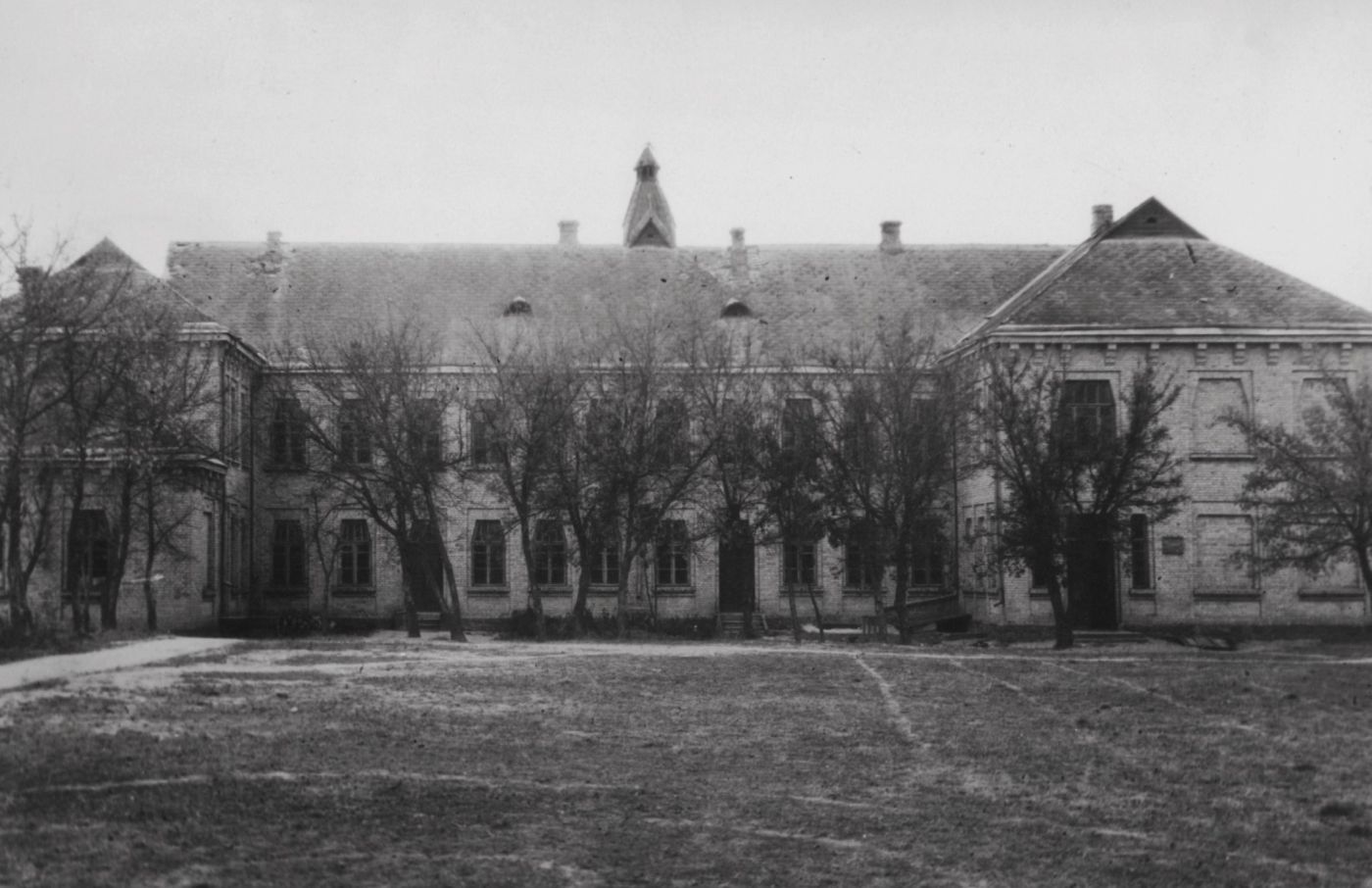
School at Kvitky village, 1937. A photo from Korsun-Shevchenkivskiy State Historical and Cultural Reserve,
I could understand Yevdokia’s desire to study medicine because her father, my great-great-grandfather Mykhailo, was a prominent bonesetter in the village. He learned this art from his uncle Hryhorii Hrynenko. The great-great-grandfather did not get a proper education, but he knew the structure of the human body and every joint and could easily set a broken bone. Dunia and Olha often saw how their father, like a magician, put broken people back on their feet. The great-grandmother Olha said that Yevdokia wanted, above all, to be like her father and cure people:
My sister wanted to enter medical school very much and she was enormously stubborn. If she desired something, she would get this, and if not, then no one could convince her.
Perseverance and great ambition helped Yevdokia to get a job in a hospital in a neighboring Korsun town where her Kvitky childhood ended.
Studying at Korsun School of Nursing
Yevdokia turned 18 years old when, in 1939, the German army invaded Poland. From July 1, 1939, she started working as a sanitary in Korsun hospital what I found out from her employment record book. Although the record of this job stands first in the book, I assume she began working earlier. On November 13, 1939, Yevdokia entered the Red Cross Society of Ukrainian SSR and Korsun trade union of healthcare workers which is proved by her membership certificate of the Red Cross Society and trade union membership card.
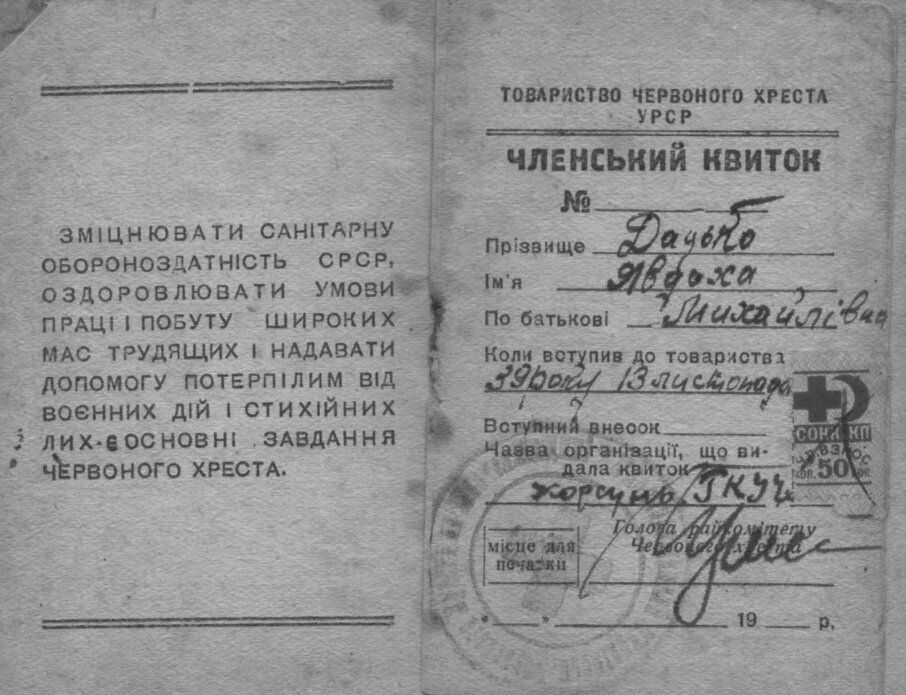
First page of Yevdokia Datsko’s membership certificate of the Red Cross Society of the Ukrainian SSR issued on November 13, 1939. A document from Korsun-Shevchenkivskiy State Historical and Cultural Reserve,
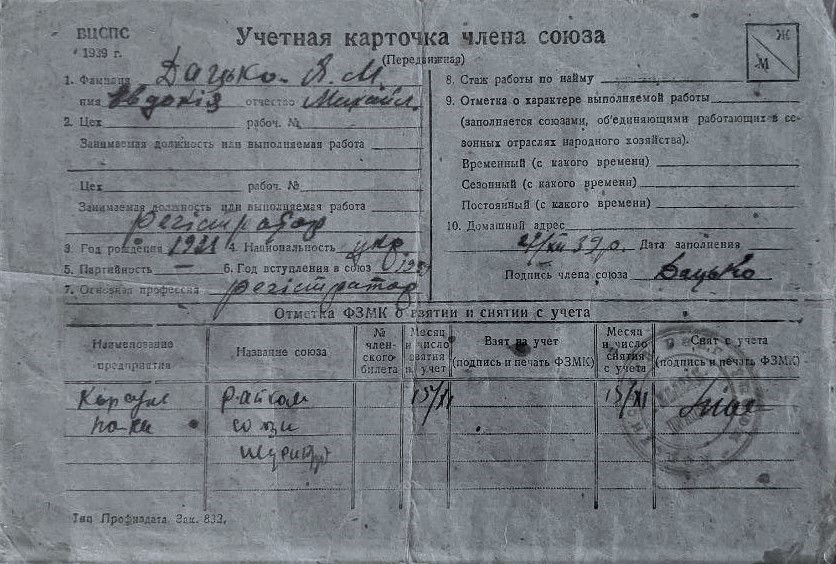
Yevdokia Datsko’s trade union membership card. A document from Korsun-Shevchenkivskiy State Historical and Cultural Reserve,
Presumably, that fall, Yevdokia started studying at the Korsun School of Nursing in the evening program. It was very complicated for villagers to get access to education at that time but Hanna Stetsenko, a sister of Ukrainian composer Kyrylo Stetsenko and the father Mykhailo’s friend, and neighbor, helped Yevdokia to enter the school. Hanna was married to Korsun doctor and Dunia lived in their house while she was studying in the town. My great-grandmother says that her sister studied for 3 years but according to her documents, the studies lasted one year. Pursuant to Yevdokia’s school completion certificate, she studied well and graduated on November 15, 1940.
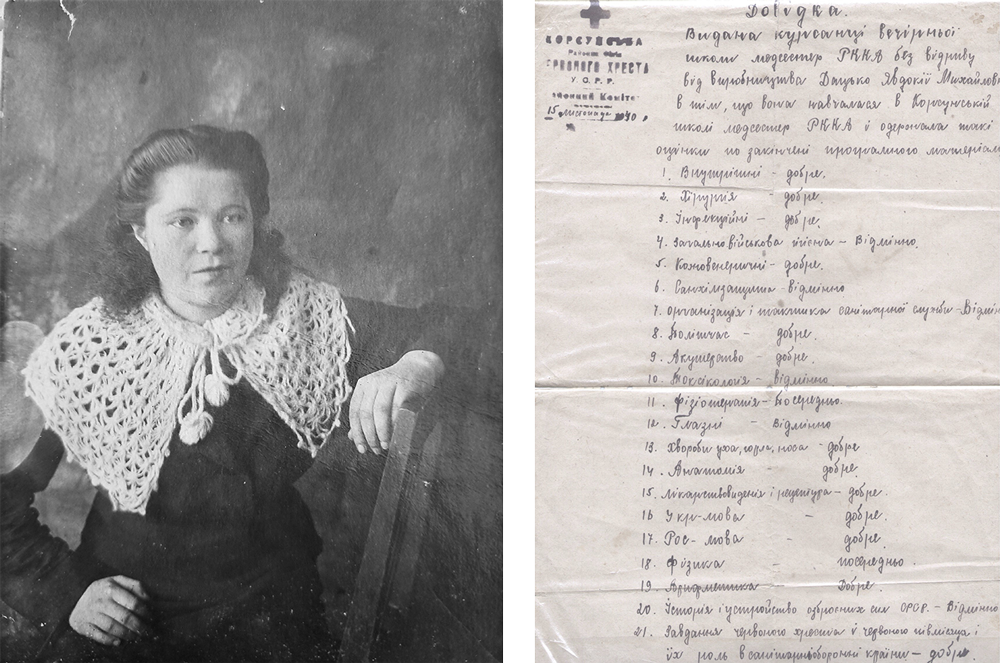
Yevdokia Datsko at Korsun School of Nursing, the late 1930s. A photo from Korsun-Shevchenkivskiy State Historical and Cultural Reserve,
Yevdokia’s Korsun School of Nursing completion certificate issued on November 15, 1940. A document from Korsun-Shevchenkivskiy State Historical and Cultural Reserve,
Yevdokia continued working at Korsun hospital along with her studies, according to two records in her employment record book: as of December 16, 1939 – a receptionist, and as of February 18, 1941 – a nurse.
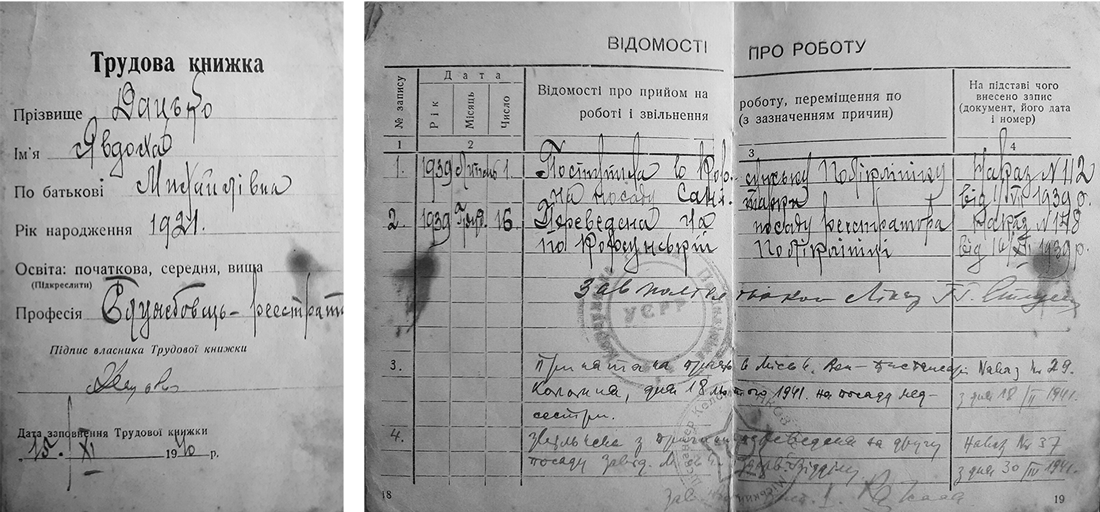
Yevdokia Datsko’s employment record book. A document from Korsun-Shevchenkivskiy State Historical and Cultural Reserve,
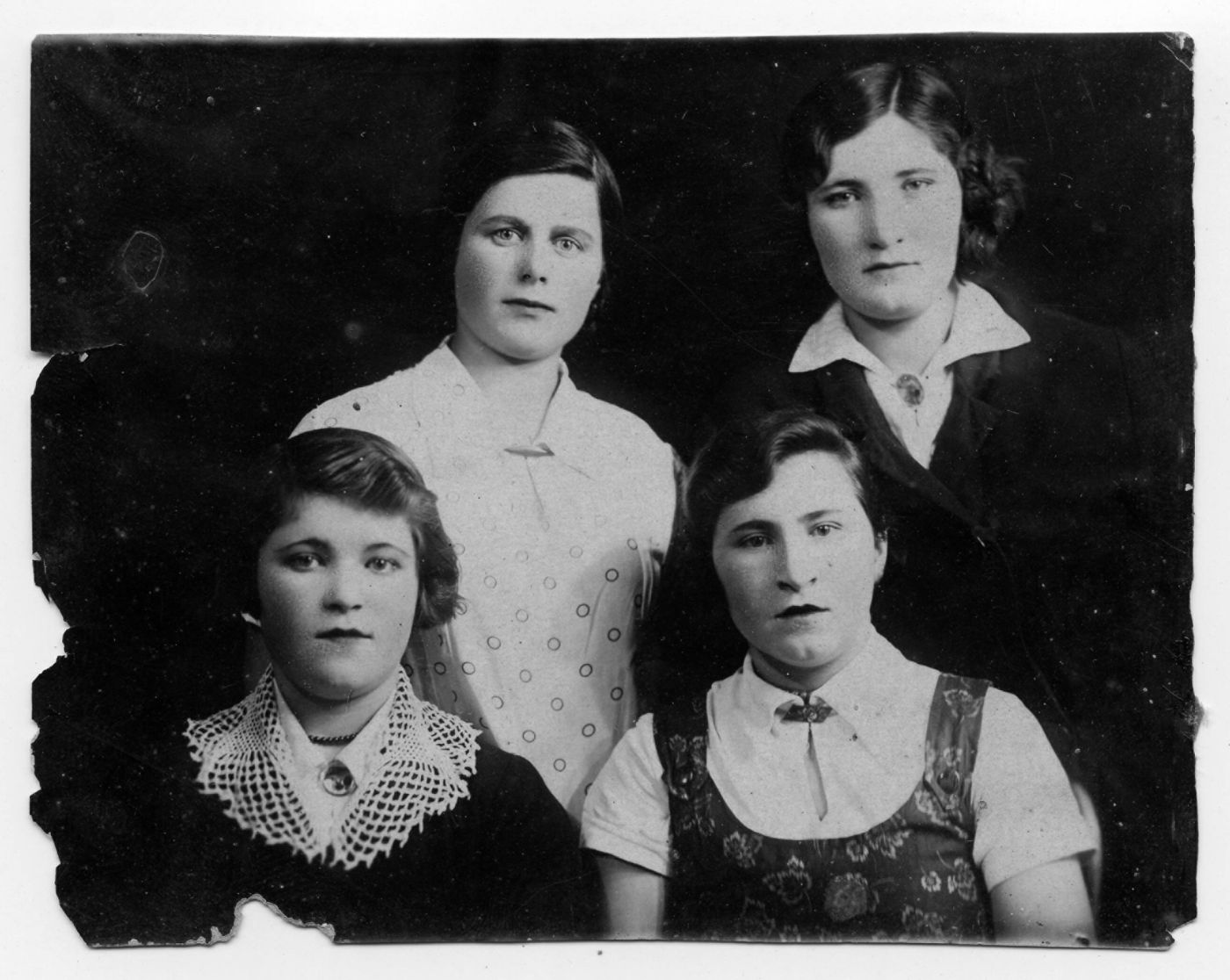
Yevdokia Datsko (in the lower row on the left) with her friends Tetiana Kvitka (in the lower row on the right), Kateryna Dmytrychenko (in the upper row on the left), and a friend whose name is unknown (in the upper row on the right) in the time when they studied at Korsun School of Nursing, 1939. Family archive
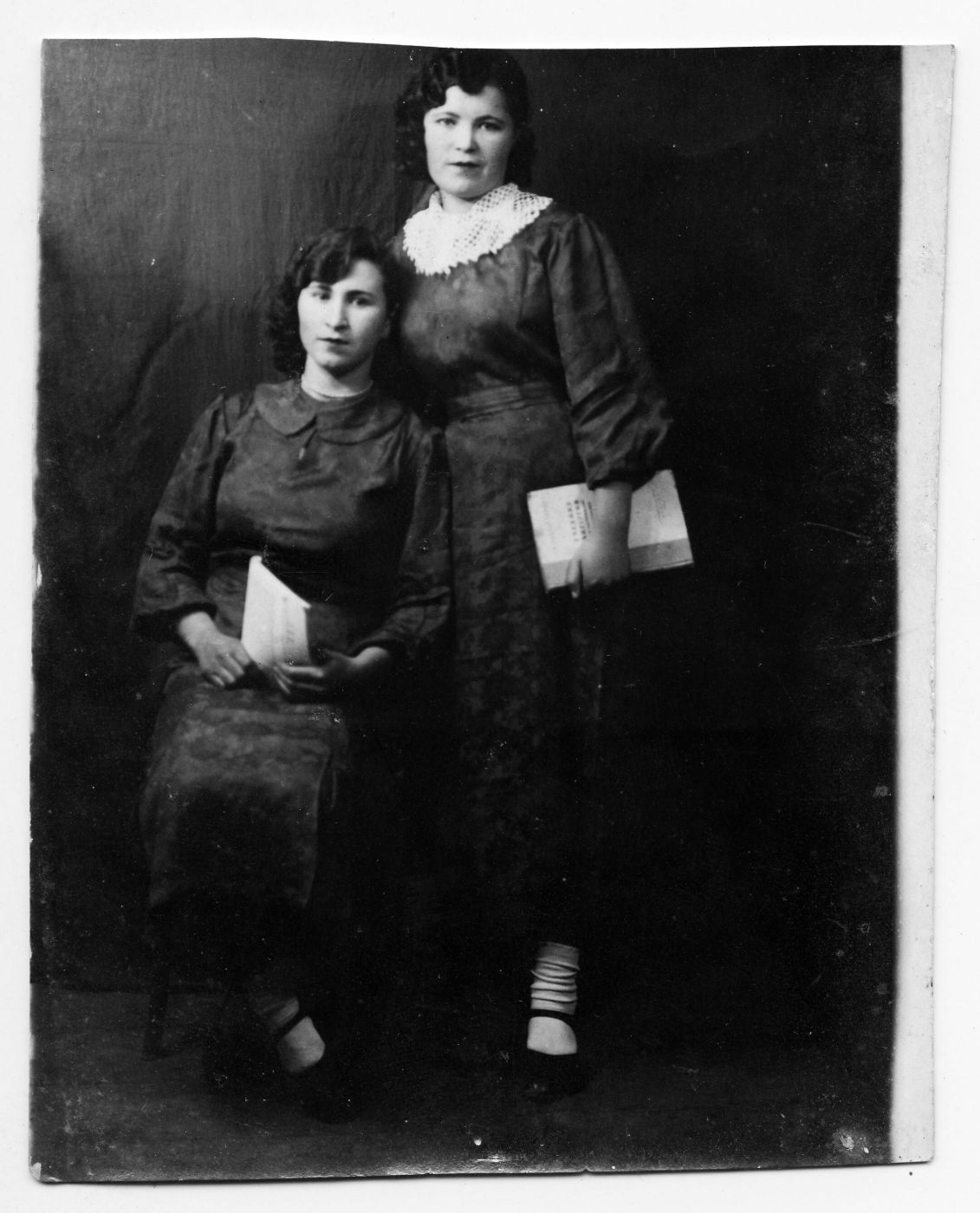
Yevdokia Datsko (standing) with a fellow student Tetiana Kvitka in the time of studies at Korsun School of Nursing, October 19, 1940. Family archive
Dunia frequently visited her mother and sister. Almost every Sunday, she walked from Korsun to Kvitky on foot (about 20 km) and always brought little gifts for her younger sister. The great-grandmother Olha shared an episode with me when on one such visit, she stole her sister’s red ribbon which Dunia’s friend had given to her for the performance. Yevdokia could not find the ribbon anywhere until she realized that Olha had taken it. But when she found out, she was not angry with her sister:
She was very kind to me, a very kind sister. I treated her worse: bossed her around and wanted everything my way, and she had to obey.
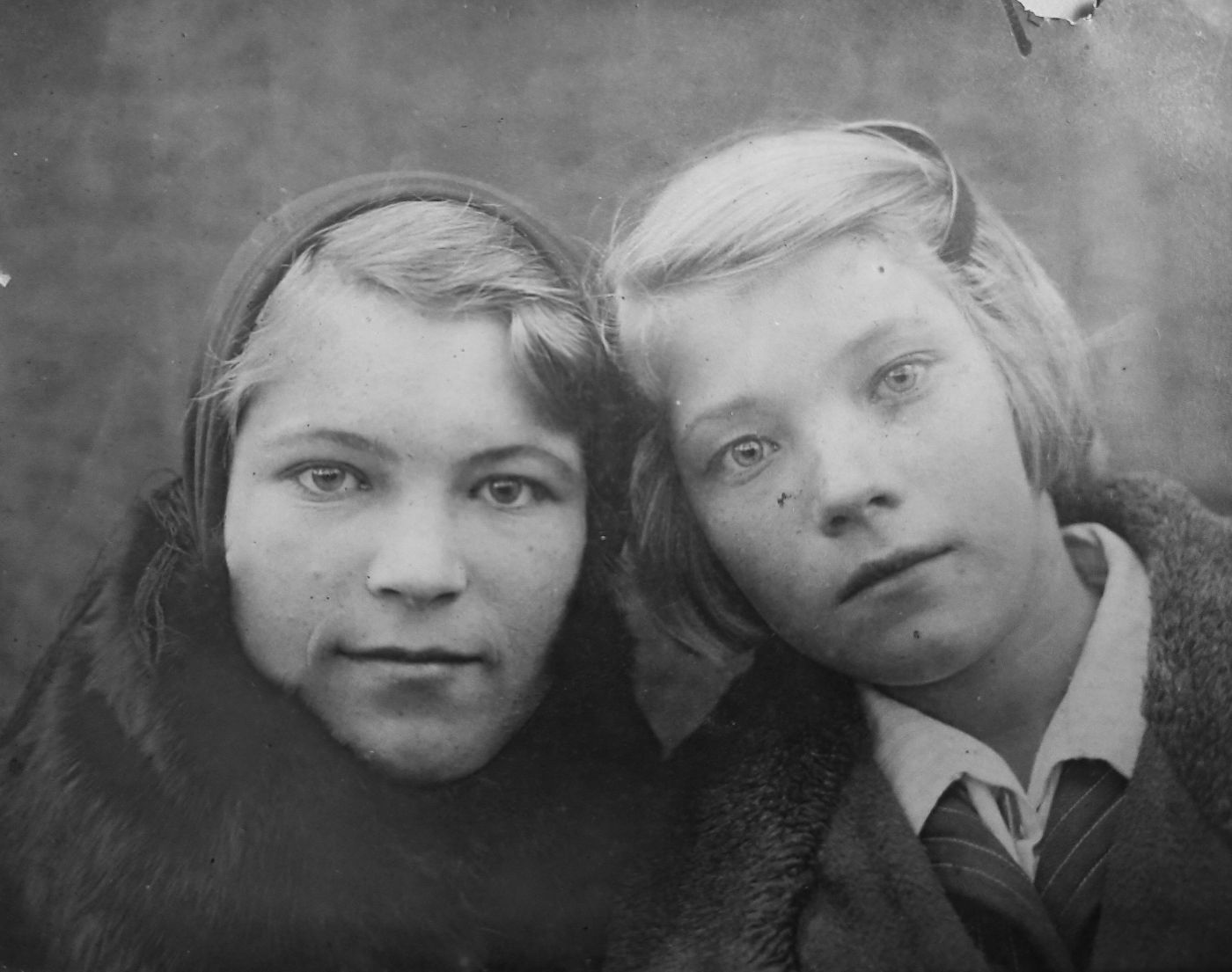
Yevdokia Datsko (on the left) with a younger sister Olha Datsko (on the right), the 1930s. A photo from Korsun-Shevchenkivskiy State Historical and Cultural Reserve,
In 1939, her father Mykhailo returned from imprisonment. That year Yevdokia met her husband-to-be – a military Andrii Fesunenko. He was originally from Korsun but carried out a military service in the territory which is now Ivano-Frankivsk region. At that time, the Soviet army had already occupied that area. That winter, Andrii, having a vacation, visited his parents. Andrii and Yevdokia got married the following year and later moved to then-Soviet Kolomyia town where he served:
Once, there appeared a soldier, and he started courting her. He courted and courted until she agreed to marry him. So father harnessed horses, put his daughter in the cart, and took her to Korsun with the rags she had. No matter how little clothes she had, they were her own. When her father brought her, a couple married and went to Ivano-Frankivsk city.
The next record in her employment book was that from May 20, 1941, Dunia started working as a nurse in a kindergarten in Kolomyia city.
Short Kolomyia period
After Yevdokia moved, she often wrote letters home describing her family life and work and sent gifts to her younger sister. In the family archive, we have one photo of Yevdokia and Andrii in 1940, probably taken in Kolomyia, which captures that short period of her life.
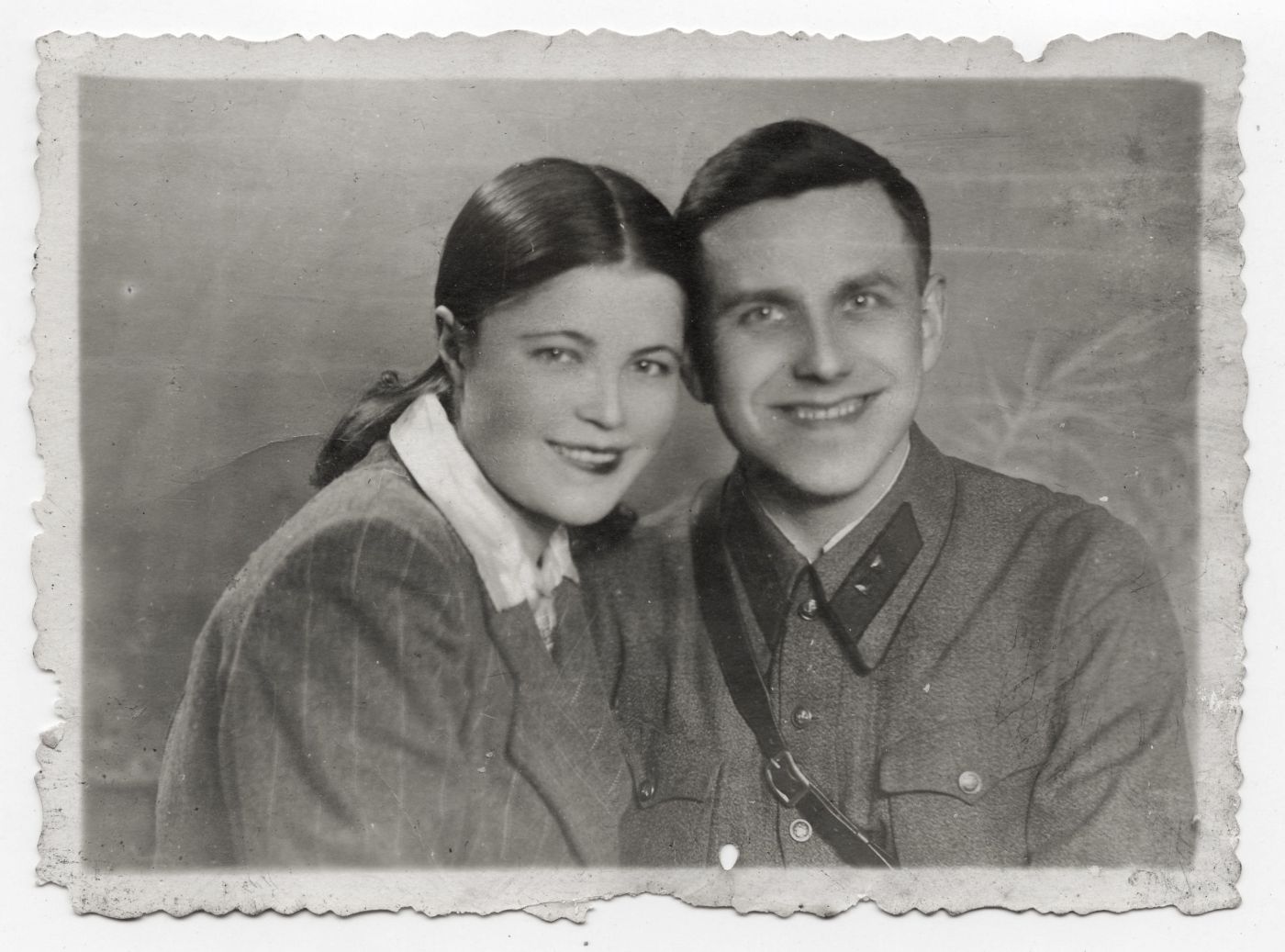
Yevdokia Datsko with her husband Andrii Fesunenko in Kolomyia, 1940. Family archive
Having left her home, Dunia didn’t know that she would never see her parents and sister again. In around 1941, her father Mykhailo and some other men from Kvitky were sent to Moscow to build fortifications and later – to the frontline. After the war, her parents divorced, and Mykhailo returned to Moscow, where he got married and lived with his new family until his death. The younger sister Olha was sent to Germany for forced labor in August 1943, and her mother was left alone. Yevdokia didn’t even have time to change her surname after the marriage because, on June 22, 1941, Nazi Germany invaded the Soviet Union, and on the following day, she was mobilized, as a person liable for military service, to a military evacuation hospital No. 2633:
“She eagerly wanted to go to the frontline, she eagerly wanted to cure soldiers”, the great-grandmother recollects.
The last record in Yevdokia’s employment book as of June 23, 1941, was the following: “Dismissed at her own request due to departure.”
Evacuation hospital no. 2633
Working at the hospital, Dunia wrote to her sister about the great number of sick and injured soldiers:
Once, I had such a queue of patients, she wrote, that didn’t even have time to drink tea. Many injured arrived. What else? This is what I wrote: “When will you have a baby?” And she wrote back: “We’ll put it off”, it was her reply to me. So they waited till she was buried…
Only one photo of Yevdokia dating back to 1942 is left from that period. However, I assume it could have been taken earlier. She sent this photo by hospital’s military mail when she was at the front. Most likely, it was the last picture of hers. No letters were preserved, unfortunately.
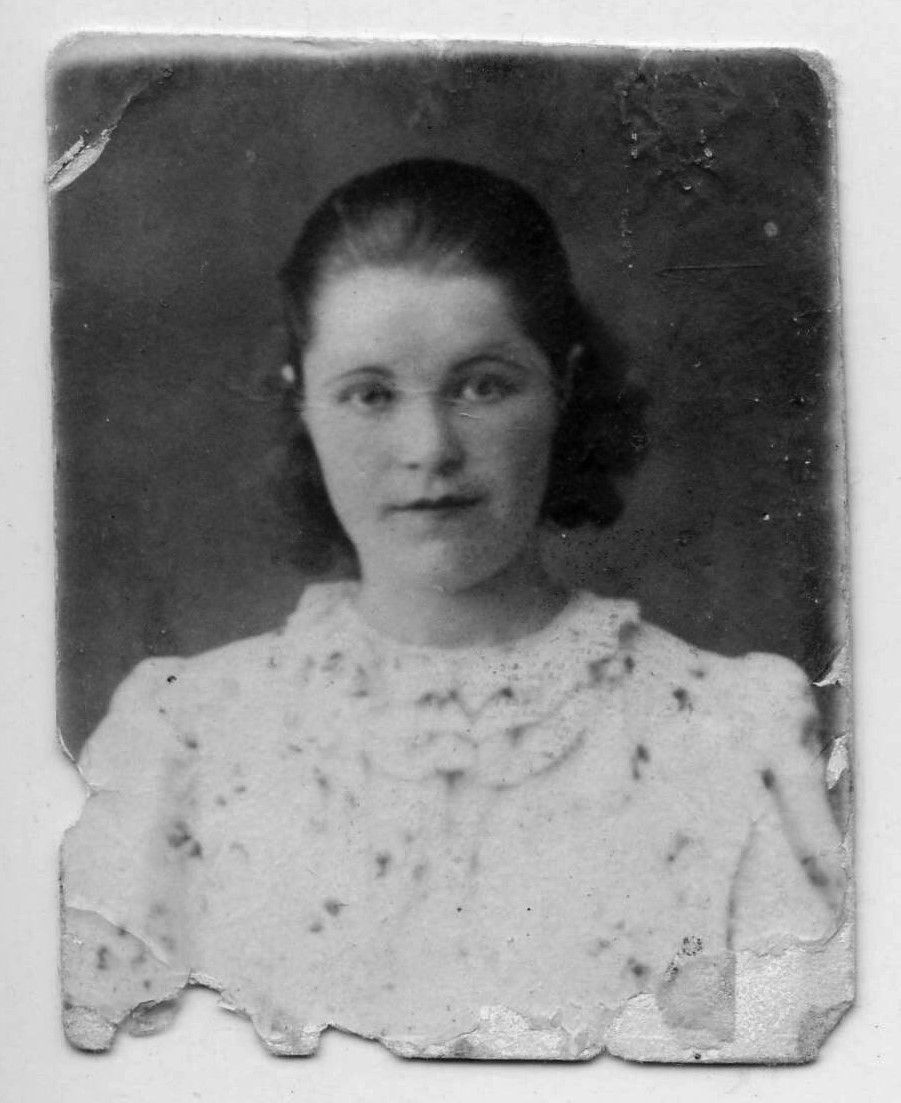
Yevdokia Datsko, 1942. Family archive
The hospital was moving around the USSR, and in 1943, it got deep into the Soviet Union territories to Kamyshyn, a Russian town (at that time – Stalingrad region, Russian SSR). In the spring of 1943, a typhus epidemic broke out among wounded Soviet soldiers there. Yevdokia carried out her obligations as a senior nurse and was the only one to take care of sick soldiers:
She was the one who wanted to care about sick soldiers. There were nurses, but everyone refused. One said: “I don’t want to die. I have a husband with disabilities.” Another one: “And I have a daughter at home, I don’t want to die.” And she said: “I have no one – no children, no husband.”
Yevdokia knew nothing about her husband’s fate. Among the documents in the family archive, I found one inconspicuous postcard. It stated that there was no reply to Yevdokia’s request on her husband’s location as of March 31, 1942. Probably, she thought her husband had died.
Yevdokia got sick with typhus in April 1943 when she was 22 years old. According to the certificate issued by the Ministry of Defense of USSR, on 1 April, a nurse Yevdokia Datsko started the inpatient treatment, and she was provided with hospital care, but after two weeks, the woman died. The great-grandmother Olha described her sister’s death:
She suffered from typhus very much, had a fever, she was burning. She knew she would die. Knew that people died of typhus constantly. Who had a stronger heart, they lived longer, and otherwise… and she went taking care of them. She had a weak heart, she was overloaded with patients, and bandaging. She wrote: “…that nurse – she had one or two patients for bandaging, and I have the whole queue.” My sister was so gentle to the wounded and gave them a feeling of relief while she bandaged them, therefore, she had a queue. She had a sincere love for a human that provided that relief, and she was generous to give them that feeling.
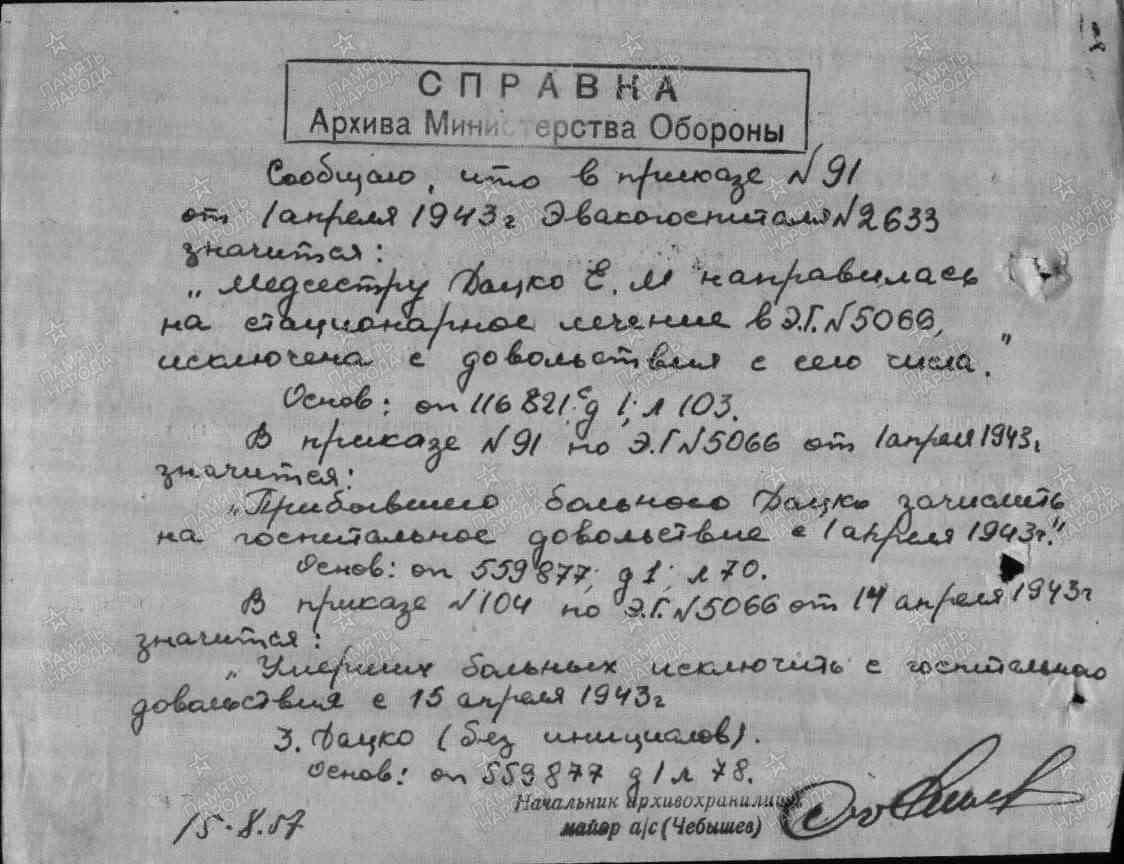
Yevdokia Datsko’s death certificate. A document from the "Memory of the People" unified database (currently blocked in Ukraine because it is funded by the Russian Ministry of Defense, which is responsible for military aggression).
From the tales of nurses who worked with her in the hospital, it is known that Yevdokia is buried in the cemetery by the hospital, where her monument was set up:
She knew that would be buried there. In the last days, she was unconscious. She wanted to “send a sister that scarf”, and they gave it to me… There were three silk dresses. Nothing was returned, nurses took those beautiful dresses, and the scarf came back home. Most important, we know where she was buried. Far-far away…
My great-grandmother still has this scarf she talked about as a memory of her sister. This is another family heirloom.
Life after war
After the war, Yevfymia received only one daughter home: Olha returned from Germany in 1945. The mother got a message about Dunia’s death in 1944 and later, she was requested to come to Dnipropetrovsk (now – Dnipro city, Ukraine), where the hospital was located at that moment. There she learned details about Yevdokia’s death from her colleagues and took daughter’s favorite scarf, some things, and documents. She also received a notice that Dunia’s golden wedding ring was sent to the Kamyshyno municipal financial department on July 5, 1943. What happened to it – unclear.
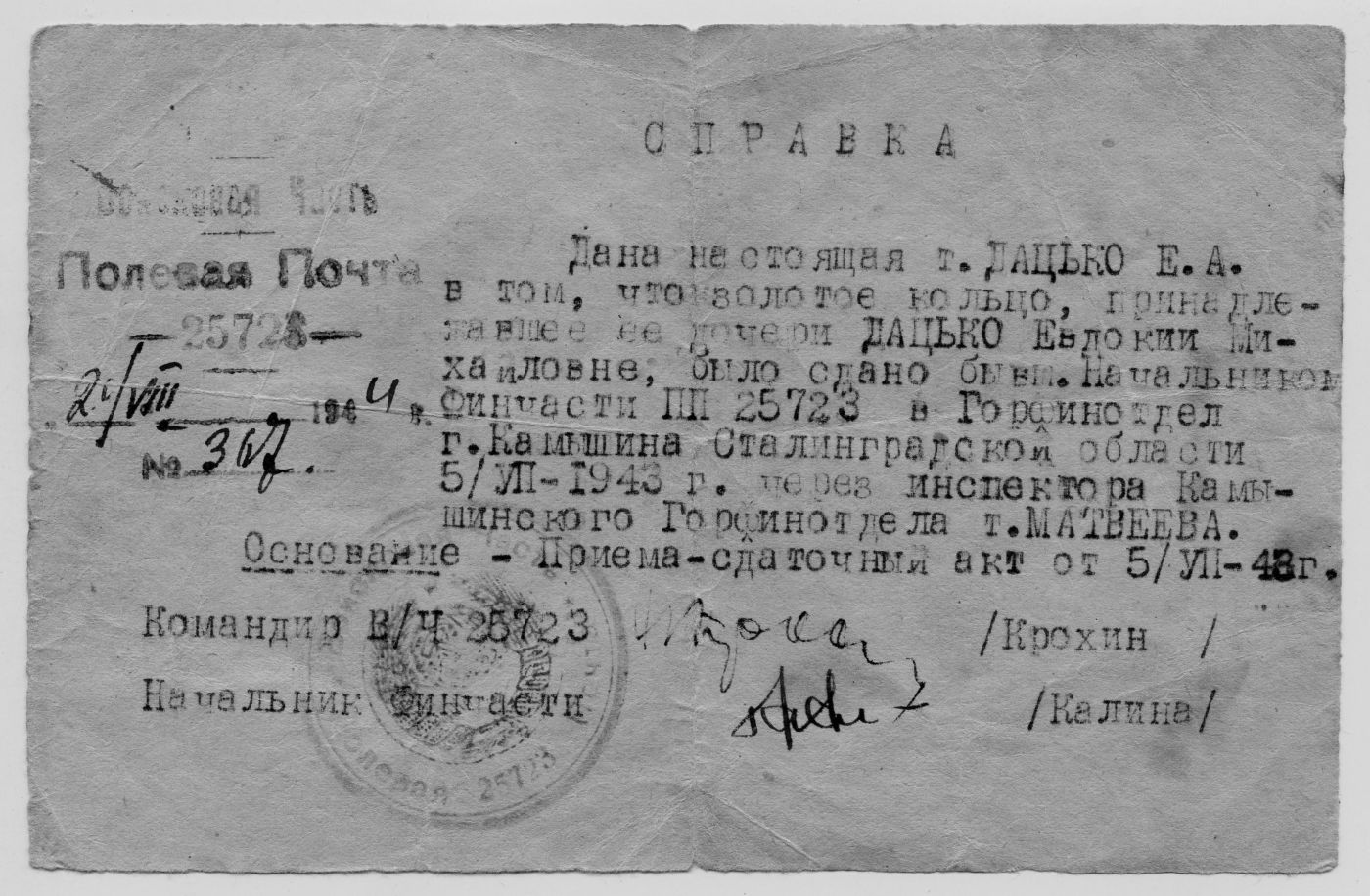
A notice about the transfer of Yevdokia Datsko’s golden wedding ring, 1944. Family archive
Andrii Fesunenko survived the war and returned home. He had been in captivity for some time, but it is unknown where and for how long – he didn’t want to talk about it. Andrii kept in touch with Yevdokia’s family for several years, but when he got married the second time, they stopped communicating. The great-grandmother knew he lived in Korsun and had a wife and two children. They met sometimes at the Korsun market but didn’t talk to each other because the new wife was against it.
In the 1950s, Evfymia tried to find more information about the circumstances of her daughter’s death: wrote letters, asked to give her relevant testimonies and documents. Later, she started receiving 12 rubles monthly from the government for Dunia’s death. The great-grandmother Olha recollected that her mother spent this money on her grandchildren – Maria (my grandmother) and Volodymyr (my granduncle). She bought them school supplies, clothes, sweets, etc. This is how she honored the memory of her daughter. 30 years after Yevdokia’s death, my grandmother Maria started studying medicine to save people’s lives like aunt Dunia.
Yevdokia Datsko had a very short but dignified life. Our family remembers her as a kind, beautiful, clever woman of principle who had a special mission – help the sick – which she accomplished at the cost of her own life. Yevdokia died almost a century ago, but she still lives in her younger sister’s memory and will live in the memory of our family.
***
According to the records of the Kvitky village council, 435 deceased Kvitky residents didn’t return from the World War II frontlines. Their names were engraved on the granite stele in the center of Kvitky village. Every May, these names are broadcast for the whole village as a sign of memory and honor. As a child, I always waited when the men’s voice would pronounce “Yevdokia Datsko”, and my great-grandmother Olha laid flowers on the mass grave closer to her sister’s name.
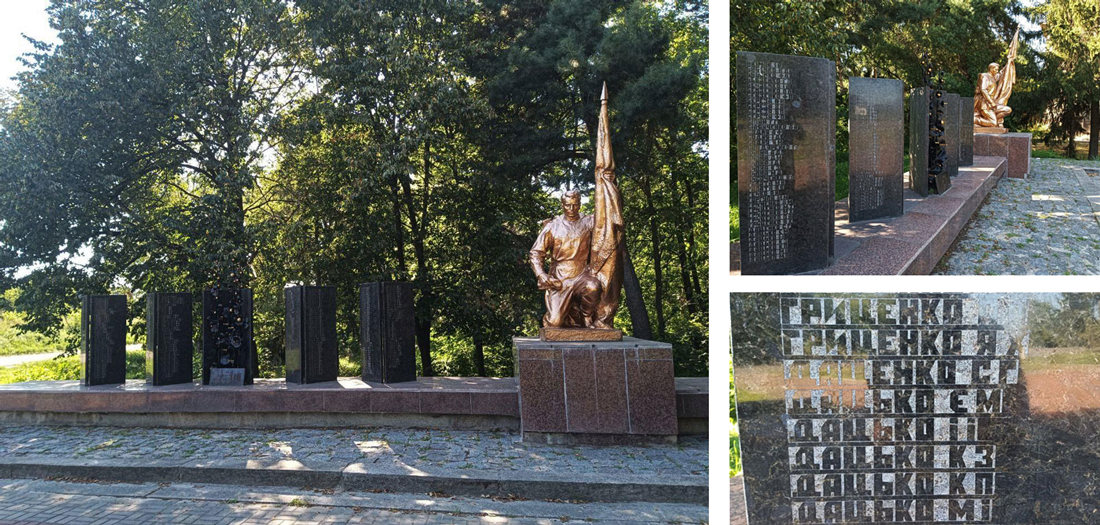
Mass grave in Kvitky village, August 2023. Photos – Stanislav Shpuntenko
Frequently, a pronounced name of the deceased in the commemorative practices of the village is the only evidence of a person’s existence. For a long time, I thought Dunia’s memory lived only in this form until I started searching for other records about her at home, in museums, archives, and my great-grandmother Olha’s memories. I didn’t know then that I would manage to find so much. As it turned out, Olha had given some of Yevdokia’s documents to the Korsun-Shevchenkivskiy State Historical and Cultural Reserve before I was born. These documents are stored there to this day. Something I could find in that archive, and some documents accidentally appeared to be at home such as the photo of Yevdokia with her fellow student from the medical school or postcard of 1942. Maybe the corners of our house hide other things too which I will accidentally find in the future. I found documents that no one in my family knew about and that let us learn much more about Yevdokia’s life and death. I encourage everyone to research their family history because there might be a great story hidden behind a portrait of a young woman hanging on the wall of the great-grandmother’s house.
I am sincerely grateful to the "After Silence" team who inspired me and let me publish this story, to Larysa Tsiomenko, a head of Kyrylo Stetsenko Memorial Museum in Kvitky village, for her help in searching documents and photos, to my family and friends for their assistance and support during the composition of this story, and especially to my great-grandmother Olha who could share her almost a hundred-year-old memories.
Text and pictures: Vitalina Mykytenko
Literary editing: Anastasiia Pravda
Translation: Dariia Titarova