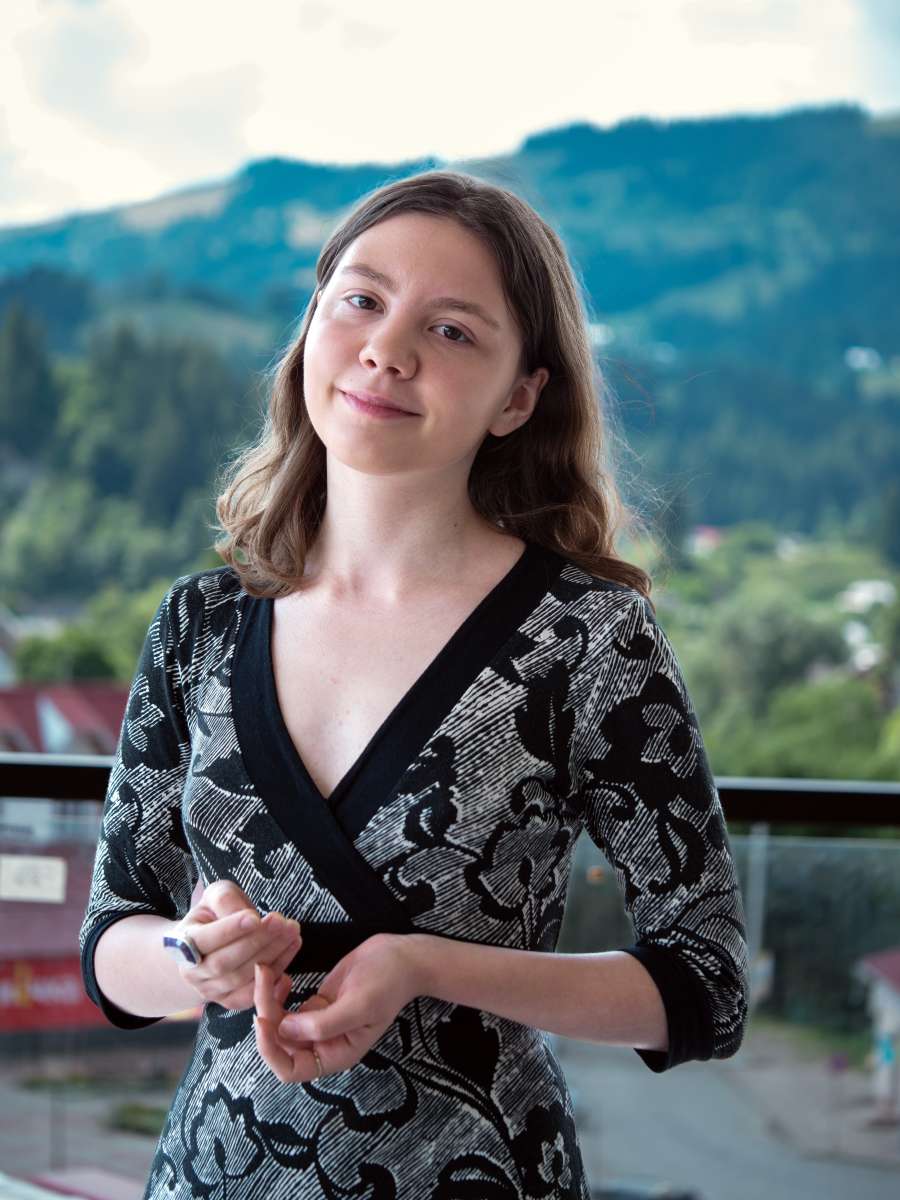
21, student of history, philology, and cultural studies
Lviv
A story of two women who raised my grandmother — her mother Kateryna Mikula and stepmother Melania Rozhankovska — connected by one husband, the town of Kalush and Maslosoyuz cooperative.
Birthday
My grandmother Natalia was born on February 24. The noon after the Russian full-scale invasion, her elder son came with a Napoleon cake, her favorite treat, for a family tea. He was dressed in a military uniform and had a tactical backpack. It was his second voluntary draft to the Armed Forces of Ukraine since 2015, in addition to his mandatory military service in the Soviet times.
In 1986, he served in the air defense forces. Now, it is a popular, exhausting, and essential specialty in Ukraine. On the night of April 26, he was on duty. Detectors registered a high level of background radiation. Later, he described that night like this: “When after several hours we found out about the explosion at the Chornobyl nuclear plant, we exhaled with relief. We already thought that [it was] America [that] attacked us and the nuclear war would begin.” The history of 20th century should be studied in the chemical protection suit.
БMy grandmother was born in 1940. A child of war. On the February morning of 2022, as on many following days, she was stupefied. The joy of her birthday was overshadowed not for the first time: on the night after her 17th birthday, her mother died.
Granny Katrusia
Granny Katrusia — that is a gentle name the family uses to refer to my great-grandmother. Kateryna (Katrusia) Vozniak (née Mikula) was born on July 12, 1912, in Louny town, 120 kilometers from Prague. It still has a large railway junction and railway carriage repair plant. Her father was a railroad worker and went to Louny for a job, where he and his family lived through World War I. They stayed in a far from the frontlines Czech town for several years and then returned to her hometown of Kalush in the Halychyna region (Galicia in some languages, part of Poland in 1919-1939). Kateryna went to a gymnasium in Stryi, and since 1930, she used to be a Plast memberPlast is a Ukrainian Scout organization patterned on patriotic and Christian values. of the Kalush girls’ unit. In the summer of 1937, Kateryna, as a delegate of Kalush town, attended a meeting with metropolitan bishop Andrei Sheptytsky — a leader of Ukrainian Greek Catholic Church, an ardent supporter of Plast movement and a patron of Ukrainian cultural revival in the early 20th century. Kateryna married Yaroslav Vozniak, a Plast scout from the StanisławówStanisławów was a name for Ivano-Frankivsk town until it was renamed in 1962. unit, in November of that year.
Sparring
When I was preparing this research, the world began to help me: Taras Zen’, a historian writing a book about the Plast organization in Stanisławów, contacted my mother in August. The researcher asked about Yaroslav Vozniak, in particular, how it happened that he, who spentall his life in Halychyna, had been born in Kyiv? I don’t know the exact reasons for sure, but I have some guesses. It was 1915, that moment when the Russian Imperial Army has occupied the Halychyna region. For the first time since the 17th century (the times of Cossack Hetmanate, Polish–Lithuanian Commonwealth, and Moscow Tsardom) there was no formal border between the two parts of Ukraine. Great-great-grandfather wanted to see Kyiv, his capital, and maybe even look for a better life there. His pregnant wife then decided to follow him. Later, the frontline moved again due to the pressure of the Austrian army, making Russian imperial troops retreat. The young couple returned home. In gratitude for the story and photos, Taras Zen’ in his turn shared with us archival photos of my great-grandparents, some of which we saw for the first time.
In addition, the historian sent a copy of my great-grandfather's report card for 1930, when he was a second-grade student in a gymnasium. My mother read the document aloud and burst out laughing: “Latin language — unsatisfactory, Greek language — unsatisfactory... Mathematics - satisfactory… He was excellent only at behavior and punctuality! Number of late arrivals — 0. Thanks God my grandmother didn’t see this record — otherwise, she would definitely not marry him.” And here is another funny story: my great-grandfather was two years younger than his fiancée. Now it is an ordinary situation, but then it was unusual, and young ladies could consider it a mesalliance. Well, great-grandfather Yaroslav added three years to his age when he introduced himself. (And it was a successful strategy, one must admit). They were about to marry and went to the church for their birth certificates. At such a crucial moment, the lie was revealed! Granny Katrusia saw the date of birth of her “wet behind the ears” (an authentic quotation) future husband in the parish register and made a b-i-i-i-i-g scandal. I don’t know how they settled the argument, but I heard about Yaroslav’s remarkable diplomatic skills (subsequently “a paragon supplier and negotiator”).
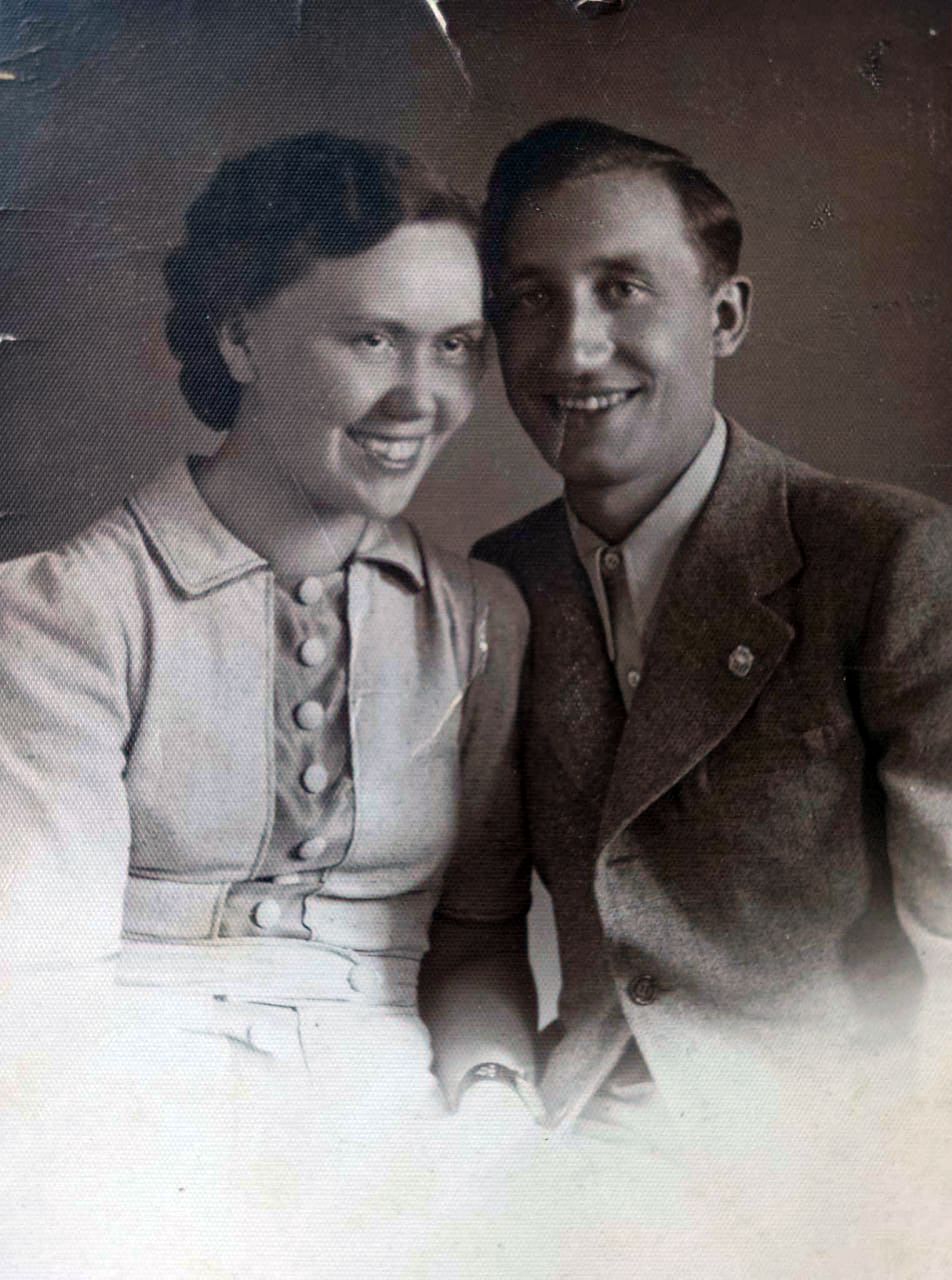
Kateryna and Yaroslav Vozniak, a summer after the wedding, 1938
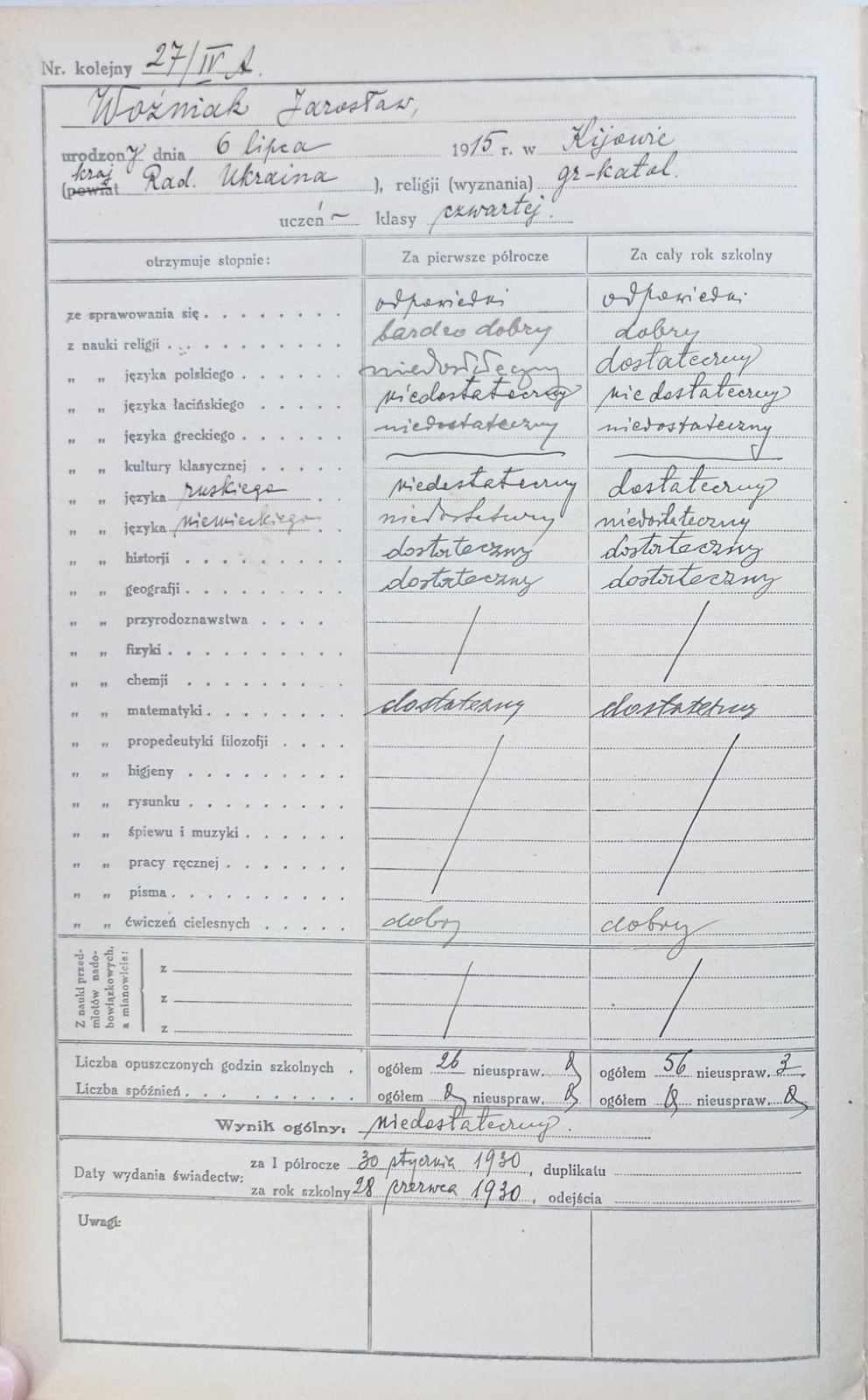
“General conclusion — unsatisfactory [level]” — a report card of Yaroslav Vozniak, a second-former of Stanisławów Gymnasium, 1930. A document from the Central State Historical Archives of Ukraine in Lviv
But very soon, it was no time to laugh (a direct response from historian Taras Zen’ follows):
“There was a state Polish holiday, and all schools in Stanisławów had to march in the city center and salute the Polish officials who stood on the rostrum. Gymnasium students boycotted this holiday. However, teachers still had to take students to the parade. And when Ukrainian students passed that praesidium, they stopped marching in lines and did not salute officials. They flocked in one group, and so boycotted this Polish holiday. It caused a scandal in the city and the Department of Education. Many gymnasium students were expelled. I think it happened that year.”
In that year — the year of PacificationPacification in Halychyna was a forcible policy and punitive actions of the Polish Sanation regime against the Ukrainian population in September-November 1930. Police and the army were involved in arrests and attacks. Churches were searched, several Ukrainian schools - closed, and Ukrainian members of Sejm - arrested, civil society organizations prohibited, and their activists persecuted. — not only Yaroslav was expelled for poor school performance but also his elder brother Vlodko (Volodymyr). Yaroslav finished his education in technical college, and under the Soviet regime, he graduated from the Institute of Commerce and Economics that had been moved from Drohobych to Lviv. Afterward, he took a responsible managing position at Tsentrosoyuz — a trading center that purchased and sold agricultural products for cooperatives in the whole interwar Poland and abroad.
Volodymyr Vozniak instead went to a seminary. His life turned out to be staggering. He became a military chaplain, and in 1942, Germans arrested him. The circumstances of the arrest remain unknown. The relatives recall that two German officers broke into the church and interrupted the service. Then, there must have been a miraculous transfiguration since a priest hit the German in the face. At a young age, he practiced boxing, so he had a good hook: “A policeman barely came around, and Vlodko was arrested.” He survived a prisoner-of-war camp in Nazi Austria and, after 1945, left the area of the Soviet occupation towards the West. I will mention him in this story more than once.
Butter and ideology
My great-granny Katrusia worked as a saleswoman at MaslosoyuzMaslosoyuz cooperative is an association of dairy producers (specifically butter producers) in the Halychyna region. cooperative and continued working after she got married (before having children), which was a sign of an emancipated woman at that time. Her workplace matched her civic activism. Maslosoiuz was not just a shop chain. In terms of industry and ideology, it belonged to the Ukrainian cooperative movement under the motto which may have the following translation: “Birds of a feather flock together.”
“This is about a lack of trust!” my friend noticed. It is true. In conditions of pacification and economic repression, mutual distrust reigned in the 1930s in the Halychyna region, which was considered a strategy for the nation’s survival, especially starting from World War II. Ukrainians found their cooperatives a kind of economic self-defense and resilience to occupation, and the request to buy exclusively brethren’s products undermined the Polish economy from the inside.
“Gentle” Maslosoyuz was one of the most successful associations. Established after the Danish and Czech examples of dairy enterprises, the customer-oriented cooperative had over half a million milk providers in 1938 and was the leader of market in Halychyna region and Poland. It even exported a small share of its production to the countries of Western Europe, Manchuria, and Palestine. In my humble and biased opinion, Maslosoyuz had the best marketing ever in Ukraine.
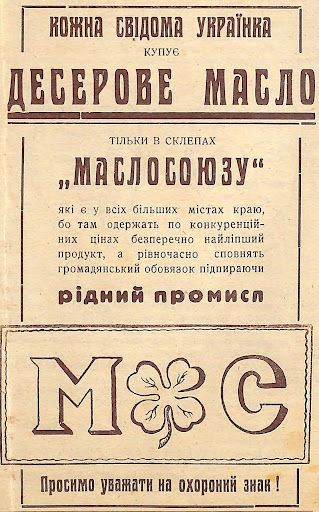
“Every conscious Ukrainian woman buys dessert butter only at Maslosoyuz stores that are located in all cities and big towns of the region because there they can receive the best product at competitive prices and conduct their civil duty by supporting local business” — a Maslosoyuz advertising message, the 1930s
Later, the third party used the Polish-Ukrainian interethnic conflict. The German occupational power made a bet on Ukrainians: they let more Ukrainians fill the administrative positions and lifted some economic restrictions that had existed in interwar Poland. Germans hoped for loyalty from Ukrainians, considering them a numerous and resourceful group of people. Under the Soviet occupation in 1939-1941, Maslosoyuz property was nationalized. After 1941, the German authorities planned not to return the property of the cooperative but to turn the cooperative into a branch of the German structure. Instead, they made it a department of the German establishment. The legal status of Maslosoyuz and district dairies was preserved at the price that the supervision of production was taken over by a German commissar.
In the open sources, the story of Maslosoyuz ends with dizzying pre-war achievements with a small remark: “Maslosoyuz was eliminated with the advance of the Bolshevik regime. In 1944, the Ukrainian dairy cooperation, as well as the entire cooperative movement, stopped existing as an independent household sector.”
Most of the enterprise’s executives ended up in exile.
World War II
The war continued, but the flags changed. In February 1945, my grandmother’s brother Bohdan was born. He was named after Kateryna’s younger brother Bohdan Mikula, who died near Brody town as a soldier of the Waffen-SS “Galicia” Division in 1944. It was their first battle. He was 16. When I first heard this story, I wondered what his motivation was. My relatives consider that he didn’t have much choice: without registration in the division, the Germans did not give boys of this age the matriculation certificate. Those who refused were taken to Germany for forced labor.
Kateryna’s younger sister Mykhailina Mikula was a liaison to the Ukrainian Insurgent Army. She didn’t manage to say goodbye to her family when she was fleeing. The last time she entered the house, it was empty. She wore my great-grandfather Yaroslav’s shirt and left forever (she lived to an advanced age in Chicago, where my mother spent one year with her, and that is why I know all these stories). In the late 1980s, aunt Mykhailina, like some other Americans, received permission to visit her family in Ukraine — under certain conditions; For instance, she had to stay only in the Intourist hotel. But the home she had left forever indeed. The house was destroyed in the summer of 1944. My grandmother Natalia told me this story that was one of her first memories: “A soldier came, he was still a boy… He says: “Run away! Tomorrow, your house will be gone..” And my mother took me, and my grandmother took away a cow — all the most precious! — No one else was in the house. After a while, my mother returned to Pysarska Street and didn’t find her house. Only ashes left.”
I’ve always noticed (and never understood; P.S: proofreading this text, which I wrote in August, today, in January, I feel like I can understand the grandmother's emotions better...em>) how my grandmother recalled that soldier — still a boy — with tenderness and even love. The soldier of the army that destroyed her house. Her house and her family. But my grandmother didn’t ask much about her family. And what would they tell her, a child, about it? So weird, for family ties were very important to my granny. She nurtured and supported them, remembering the birthdays of a dozen people. As for her own past and her mother's and aunt’s biographies, she let them be blind spots and exclusion zones. But concerning her own past and the biographies of her mother and aunt, she left these blind spots, these zones of alienation. He warned them — and, therefore, saved their lives. That’s where this love comes from. It is impossible to explain.
The twins Stepha (Stephania) and Zonia (Sophia) Vozniak, great-grandfather Yaroslav’s sisters, emigrated with their families too. All of them managed to survive, but then they had to pass through camps for displaced persons, DP camps. How did they all end up in the USA? Apparently, in addition to a good hook, Vlodko Vozniak had good connections too. As a priest, he was sent to the US through the church channels. From there, he sent invitations — affidavits — first to his sisters with their families and, in 1948, to his sister-in-law Mykhailina Mikula.
“Someone should stay here”
In the summer of 1944, Kateryna and Yaroslav were expecting a baby. It was one of the reasons why they refused to emigrate with the family, who fled under the risk of repressions due to their connection to the Ukrainian Insurgent Army and the cooperative (during the Soviet occupation, citizens were threatened with repression even for entrepreneurial activity in a non-Soviet time). The second reason was “someone should stay here.” Both their mothers were getting older and very soon needed care. The price of their choice was painful. Since Kateryna’s sister was a liaison and her brother joined the division, NKVD interrogated her. Sleeping on the cold prison floor aggravated her hereditary disease — bronchial asthma. My grandmother recollected how her mother, already confined to bed, sewed her the Night costume out of improvised materials for a school holiday. She embroidered a black train with comets and constellations. She told this — and her eyes lit up.
Before Kateryna died, her husband had promised her to marry again, and her friend assured her that she would find him a decent woman because “a boy needs a mother.” Their younger son was 12 years old. Yaroslav Vozniak fulfilled his wife’s last will and approached this matter pragmatically: he proposed to a woman who had raised four nephews during the war. However, the relationships between children and stepmother were complicated: a 16-year-old Bohdan entered a tank school just to leave home. Having not stood military training and prospects of military service, he jumped from the third floor of the dormitory a month later to get injured and discharged from the service. As a result, he broke his arm. Bohdan had served in a penal military unit in Uzbekistan for three years. Then, he entered a historical faculty in Lviv, worked as a history teacher in Kalush, and educated local youth there.
Instead of going to the tank school at 16, my grandmother wanted to get married (but she didn’t get permission). She didn’t get along with a stepmother either. However, I remember her talking about Melania with firm respect. It was Melania’s house where my grandmother went to when her 2-month-old newborn son had pneumonia and was dramatically losing weight. Working as teachers, she and her husband hadn’t enough money for medicine, food, and heating. Melania saved the boy and, for 8 months, took care of him. After 56 years, he arrives at his mother’s birthday with Napoleon cake and a tactical backpack.
Ms Rozhankovska
This strong woman, femme fatale, and strict caregiver for her four nephews’ was born in Pula, now a city in Croatia, and at the time — in Austro-Hungarian Empire. Melania Rozhankovska was the daughter of Markel Rozhankovskyi, Ukrainian, a 1st-class Naval Senior Staff Doctor (Colonel), who served on the Kaiserin Elisabeth cruiser during the Russo-Japanese War. Kaiser Wilhelm II awarded him a 2nd class Iron Cross for his service. In 1918, when the Navy health service of the Ukrainian People’s Republic in Odesa started establishing Markel worked there as a civil doctor. The rest of his life, he spent as a doctor in Kalush where he planted an entire garden-and-orchard with trees brought from his round-the-world voyages just across the public town park.
His daughters Melania and Maria (Melasia and Marusia) both gained higher education in Poland just before World War II. Maria finished medicine in Warsaw, and Melania graduated from the College of Commerce in Kraków, defending a thesis “Monografia towaroznawcza masła” (Eng. Monograph on Butter as Commodity). Most likely, it was based on the activity of Maslosoyuz in Kalush.
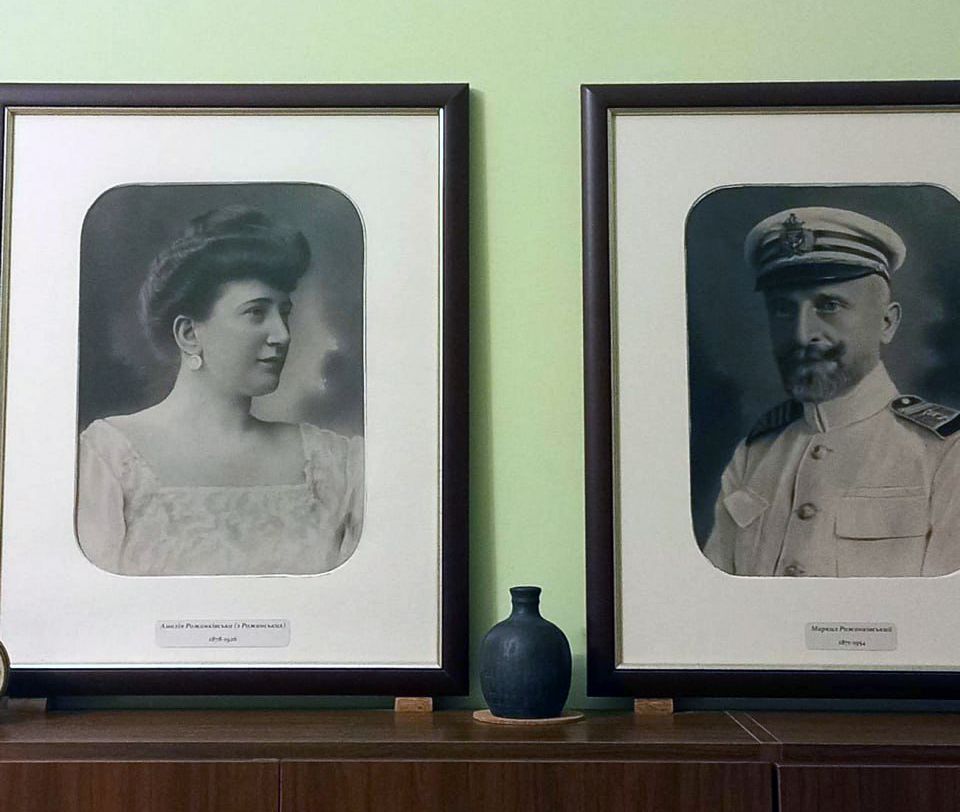
Portraits of Melania Rozhankovska’s parents Amelia and Markel
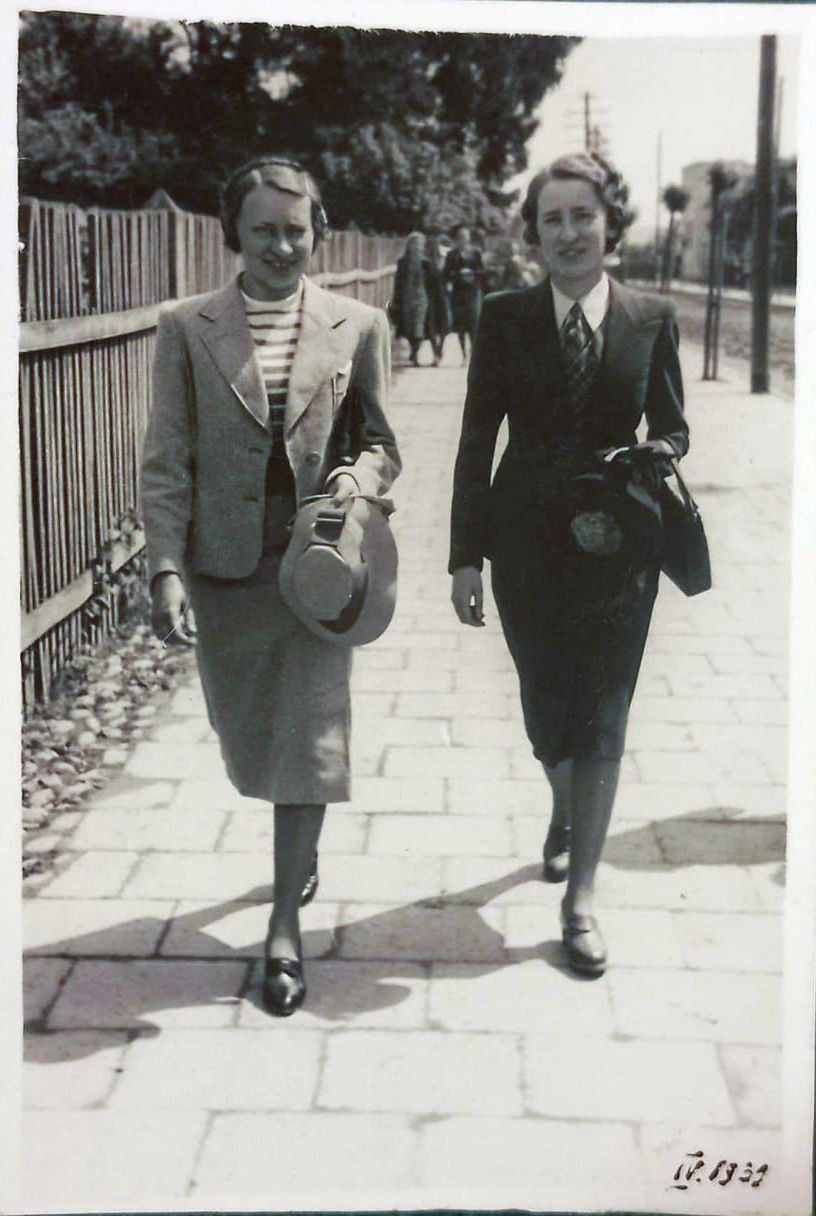
Melania and Maria Rozhnakovska, April 1939
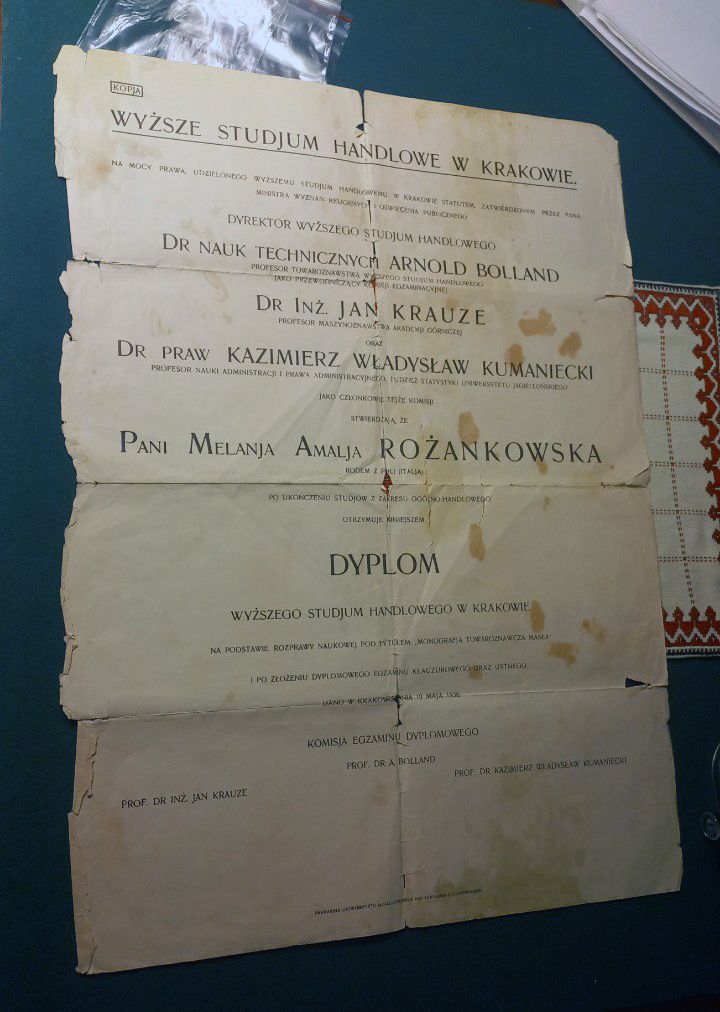
Monografia towaroznawcza masła (Eng. Monograph on Butter as Commodity). A copy of the thesis of Melania Amalia Rozhankovska from the College of Commerce in Kraków, 1936
During the Nazi occupation of Lviv and after the war, Melania helped raise her four nephews, cooked and sewed clothes for them while her sister worked as a dentist (it was considered a state job) and brother-in-law Orest (having some unspecified state job) sustaining the family.
To keep helping, Melania refused to emigrate and marry a man who invited her to flee abroad together. The Soviet regime didn’t approve of her diploma. Therefore, she took a job that needed no qualifications to avoid criminal charge of social parasitism (tuneyadstvo). Thus, the woman assembled boxes for candies at the Svitoch factory. The option of receiving a Soviet education by correspondence, as her future husband Yaroslav did, she would find humiliating. Resilient and stubborn, she literally outlived the Soviet Union, which was her bone in the throat.
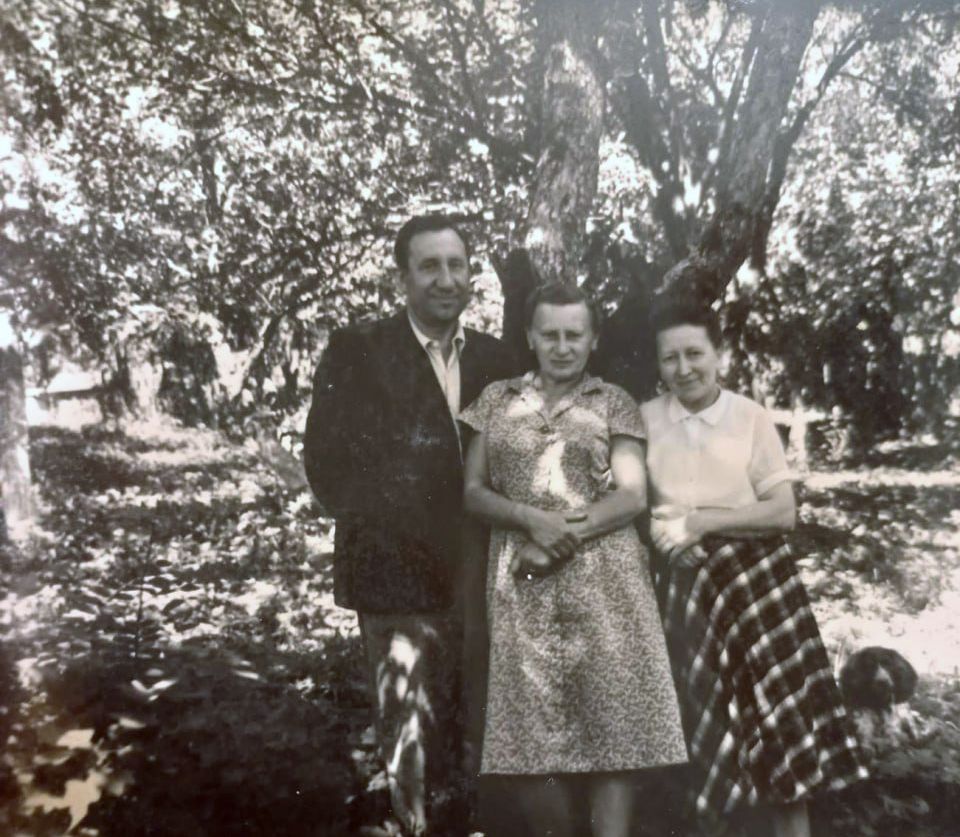
Yaroslav Vozniak, Melania Rozhankovska, and Maria Kushnir in the Kalush garden
Here they are in the garden
I saw neither the garden nor the house covered with ivy — the garden and the ivy were gone before I was born. I remember only phlox blooming around. Unfortunately, our relatives cut these old trees. The wood of the house was deteriorating and drawing moisture from the vines and leaves, thus the ivy was removed as well. The wooden planks were painted yellow, the leather couches changed the armchairs made of cherry wood… And finally, the house was sold last year. I regretted much and always that I can only imagine its past, that I never touched it. (I know this is already a lot. Besides, in the last year I’ve got to see more of it than in my whole life before...)
Markel Rozhankovkyi’s house. It sounds prestigious. But then I think: who was ready indeed to take care of it? The family that inherited this house was visiting Kalush to see a graveyard first of all.
“How’s it doing?” — “It is on sale. But no buyer on the horizon.” And then one has appeared. A family from ZaporizhzhiaZaporizhzhia is a region (oblast) in the south of Ukraine, partially occupied by Russia since February 2022. Russia is systematically shelling the infrastructure and residential buildings of Zaporizhzhia. bought this house, dilapidated during the century. They promptly agreed to everything that the house had to offer. Let their life be happy. Let it become the summer house and the second home, and Zaporizhzhia — a safe first home.
A hideout
At a memorial service for granny Natalia in November 2022, an older man approached me. He introduced himself as my grandmother’s stepcousin, Melania’s nephew. His name was Zenovii Kushnir. “I have something for you. I have something that belongs to you.” We met again 9 days later. He brought a black and white picture with a biblical scene featuring the Virgin and Child. The Virgin Mary depicted unusually: with an uncovered head and lush dark hair, she kisses her sleeping son’s hand, and her glance is self-absorbed and infinitely worried. A wooden painted frame is three times bigger than a graphic miniature itself. In the back of the frame, there is a hideout with real treasure: my family photos and a little icon from Volodymyr Vozniak’s priestly ordination (dated July 1939, a month before the previous world war).
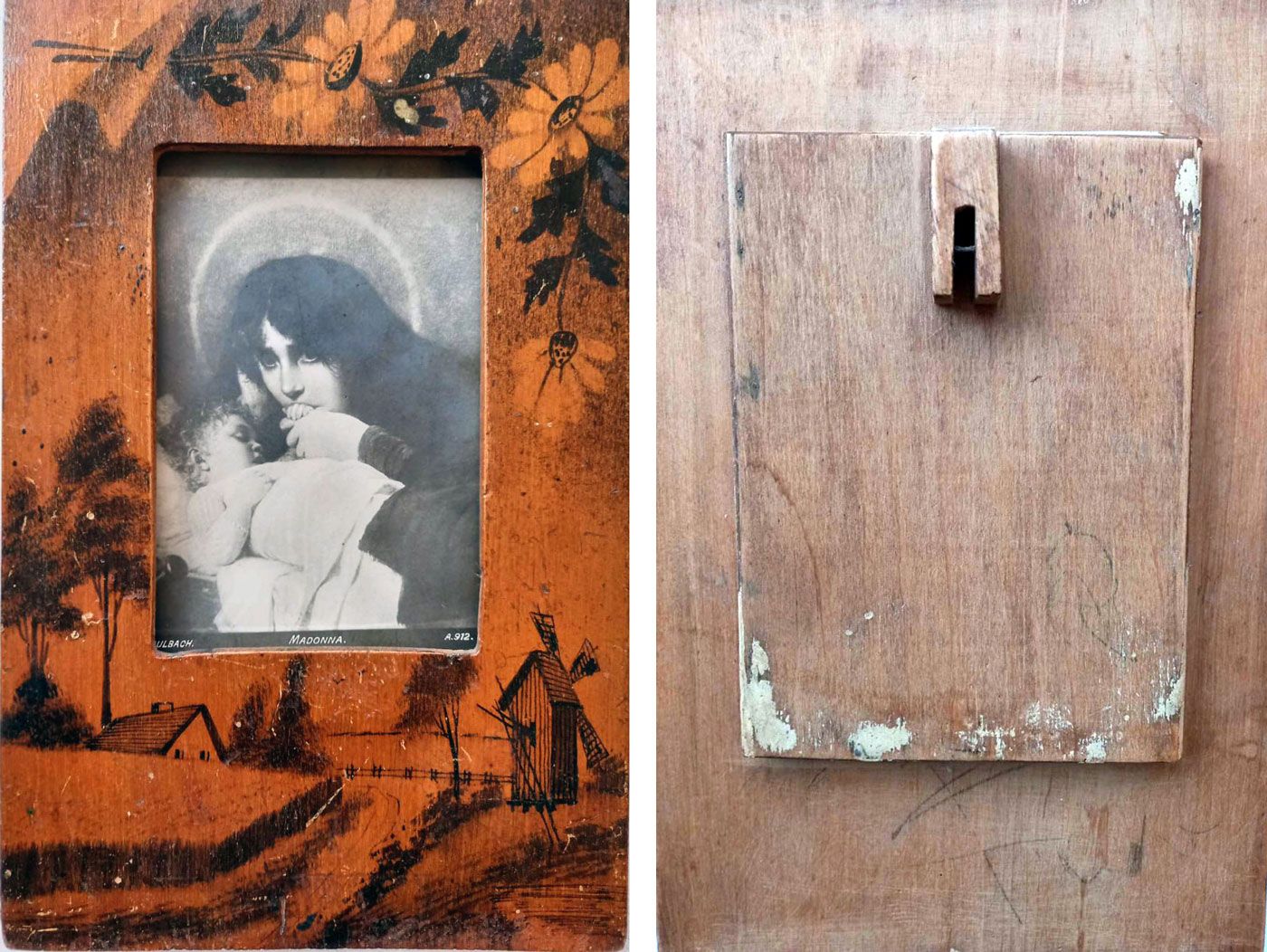
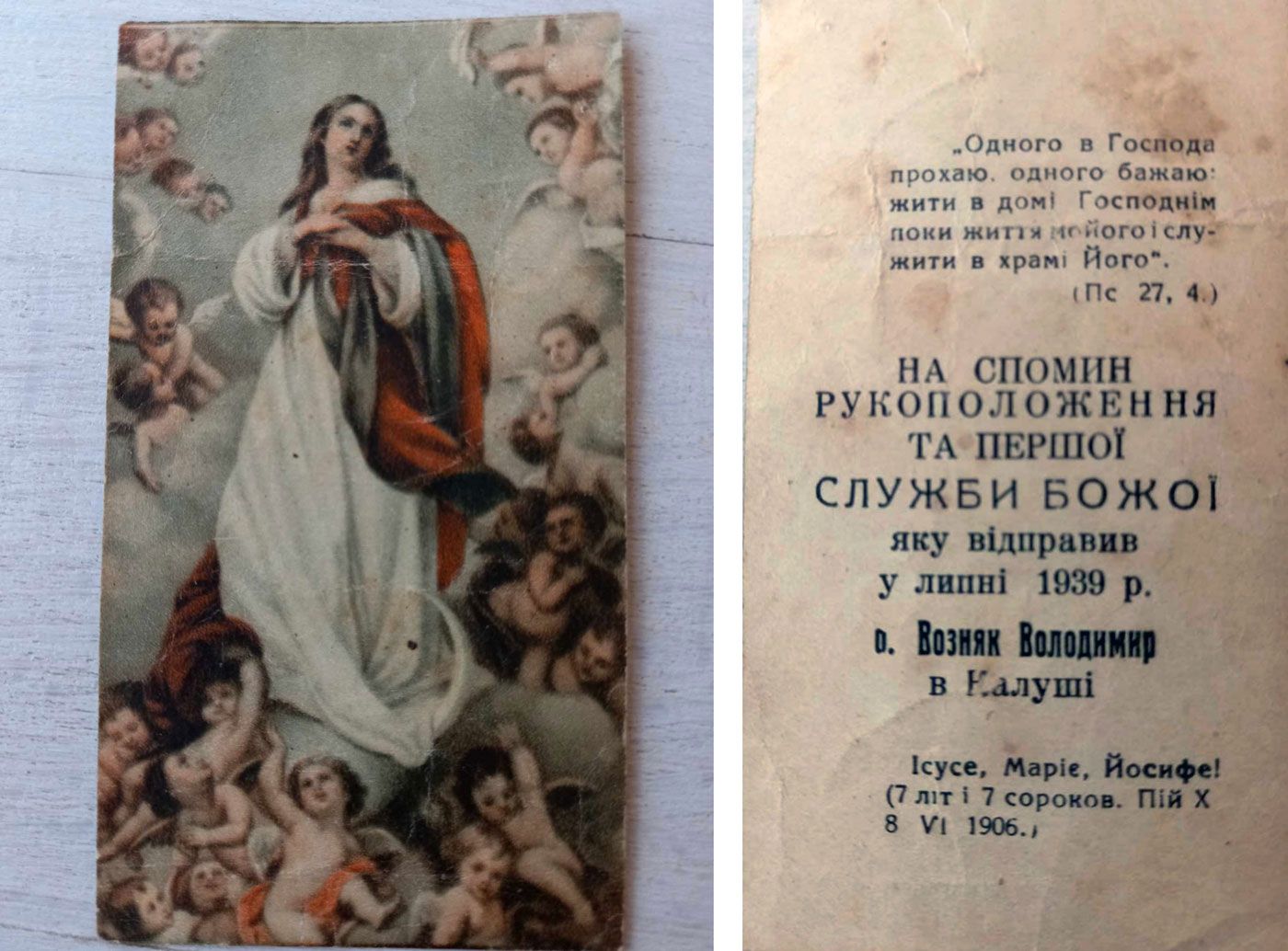
Kushnir's family thought that this picture from the bedroom of the Kalush house was their aunt’s for several decades. And now, someone being attentive picked it up and noticed that the pictures hided on the back belonged to Melania’s husband, my great-grandfather. We agreed that I’d visit them.
Their address in the city center has not changed in the last 80 years — an unusual permanence as for Lviv. Maria Kushnir’s family received this spacious 5-room accommodation from the German occupational authorities that evicted a Jewish family instead (Maria’s children don’t hide this fact and even later contacted that Jewish family who survived the Holocaust and settled in Israel). Later, the Soviets left three rooms for their eight-member family only three rooms, one of which Maria turned into her dentist's office. The new people moved in two other rooms. The dwelling turned into a communal apartment. Even my grandmother lived here for two years when she entered the Lviv University. Since then, she had a warm connection with Kushnir cousins filled with deep mutual respect.
I walked through the rooms and felt myself in a museum. And here, I could already touch history through things. A wooden armchair with carved relief chrysanthemums of Japanese war times. Restored furniture. A Kosiv ceramic vase painted in typical yellow, brown, green, and even blue — the color that came to the Carpathians through Armenian culture, as my friend from Kosiv explained. The Virgin with Child pictured by Olena Kulchytska. Graphics of Bohdan Soroka and Nil Khasevych. A round card table covered with green felt. We sat at this table, and Zenovii showed me a copy of the Kraków diploma and old album photos. We stopped at every picture, identified the photographed circumstances and people there, and listened and listened.
Few things give me such a sense of engagement with living history as archival photographs (especially of my family). There is a well-known garden-and-orchard, Limnytsia riverLimnytsia river flows through the town of Kalush., rare pictures of Lviv in 1943 — Akademichna street in times of the Nazi occupation. I wrote so much already. And now, I invite you to have a look.
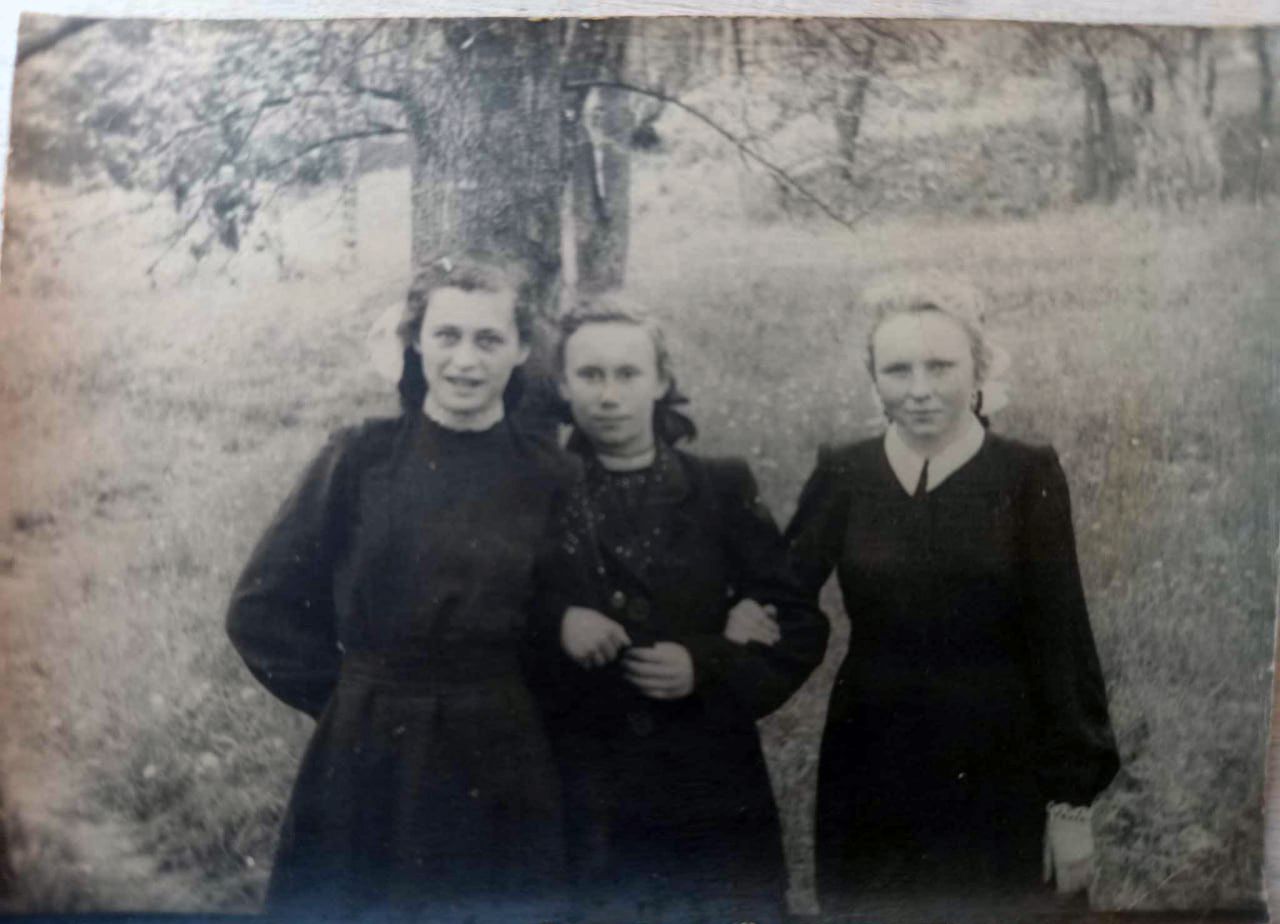
Natalia Vozniak (in the center) with friends in a school uniform, the 1950s
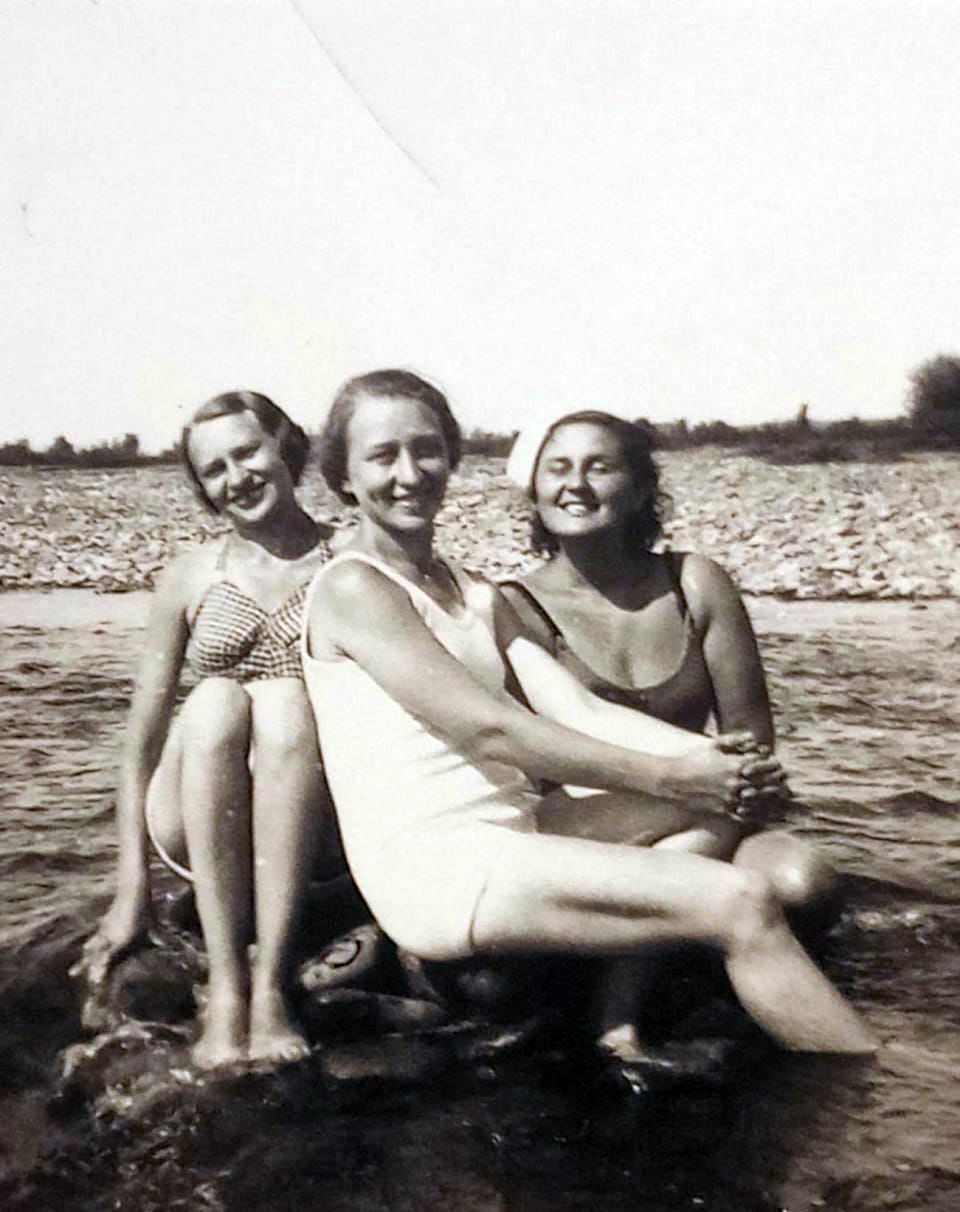
Melania (on the left) and Maria (in the center) Rozhankovska with a friend by Limnytsia river, the 1930s
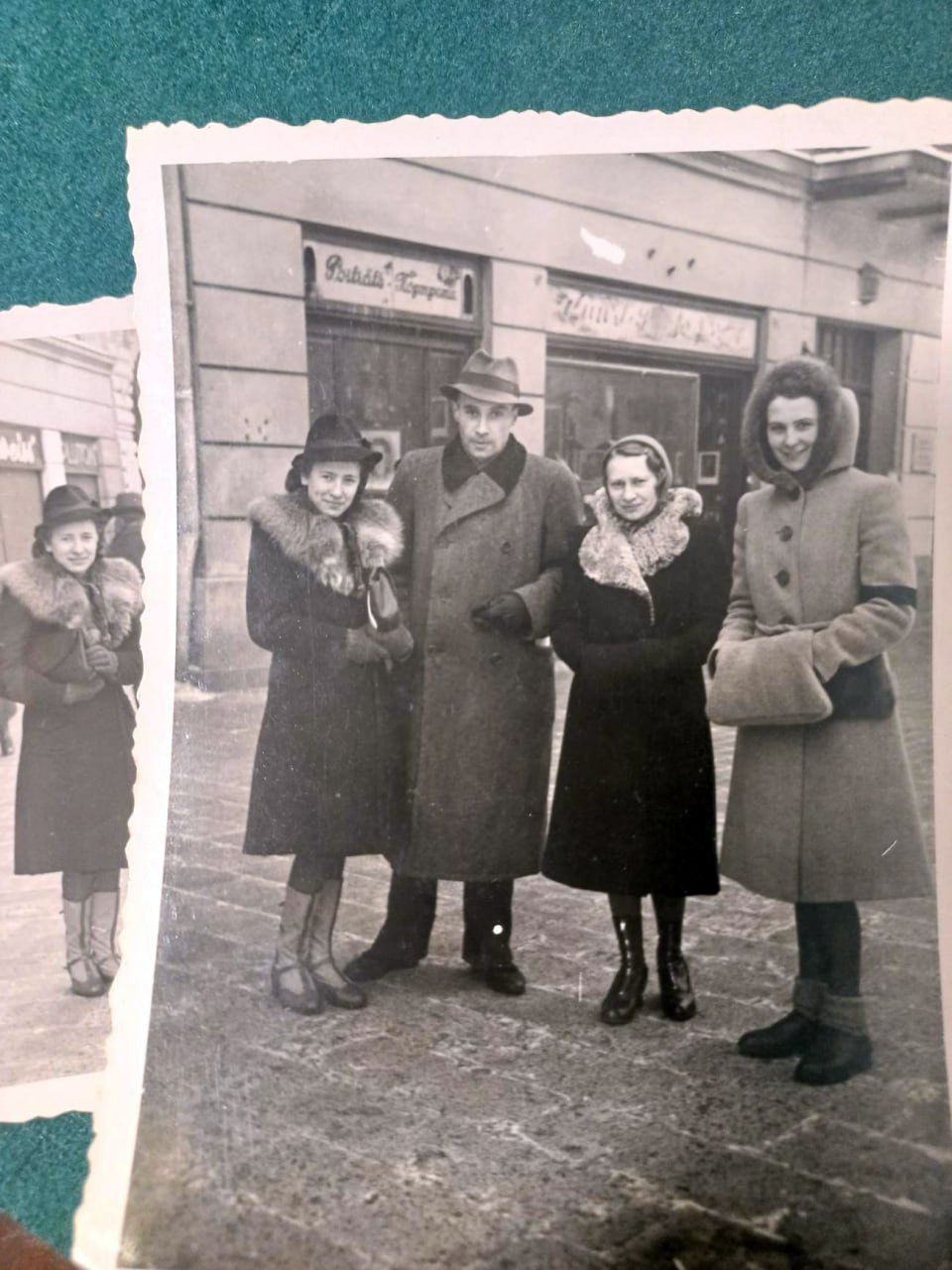
Melania Rozhankovska (in the center) in the company at Akademichna street in Lviv, October 1943
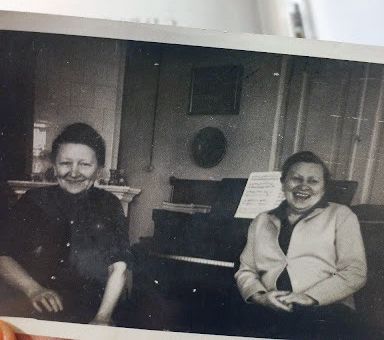
Rozhankovska sisters in their apartment in Lviv, the 1970s
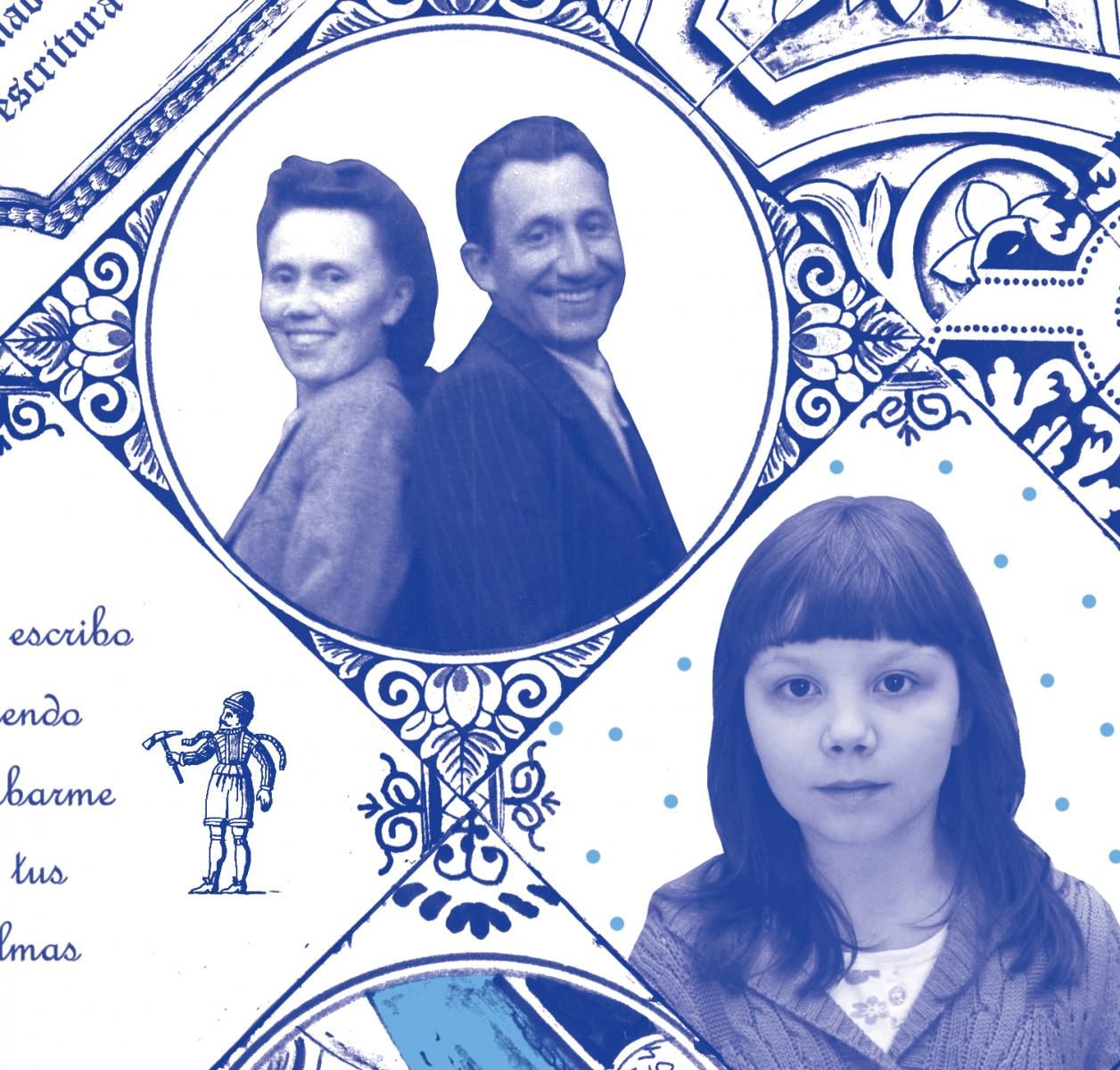
A photo collage with my great-grandparents (1949–1950) and me as a child for my mother’s poetry book. Art studio Agrafka, 2015
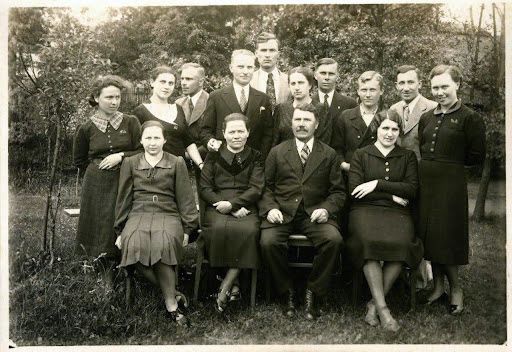
People sitting (from left to right): Nastka, Anna, Hilliarii, Varvara Mikula.
People standing (from left to right): Karolina, Marta, Osyp, Volodymyr, Stephan, Yevphrosynia, Markiian, Bohdan Mikula, Yaroslav and Kateryna Vozniak.
May 1939, Kalush
***
In 1938, a Kalush photographer P. Vozniak took a picture of granny Katrusia in the uniform of Maslosoyuz saleswoman. A photo portrait with the caption “The girl of Maslosoyuz!” had stood in the window of his photo studio for many months (named after the popular operetta of Yaroslav Barnych premiered that year). A family house in Kalush did not survive, but this photo was miraculously saved. Now, it is the most precious family heirloom for me and my mother.
The photographer had the same surname as my great-grandmother’s husband. And my grandmother Natalia had been jokingly waiting all her life for the American Steve Vozniak to reappear to the family.
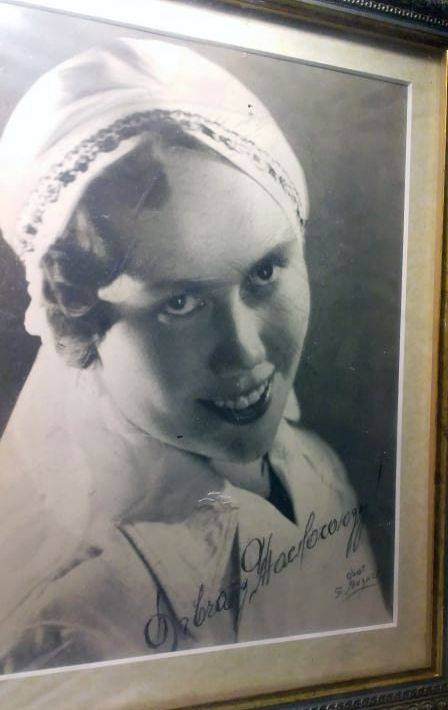
Kateryna Vozniak, 1938 рік
Text and pictures: Khrystia Leshchuk
Literary editing, proofreading: Anastasiia Pravda, Yevhen Redko, and students of the Ukrainian Catholic University
Translation: Dariia Titarova, Roman Hardashuk